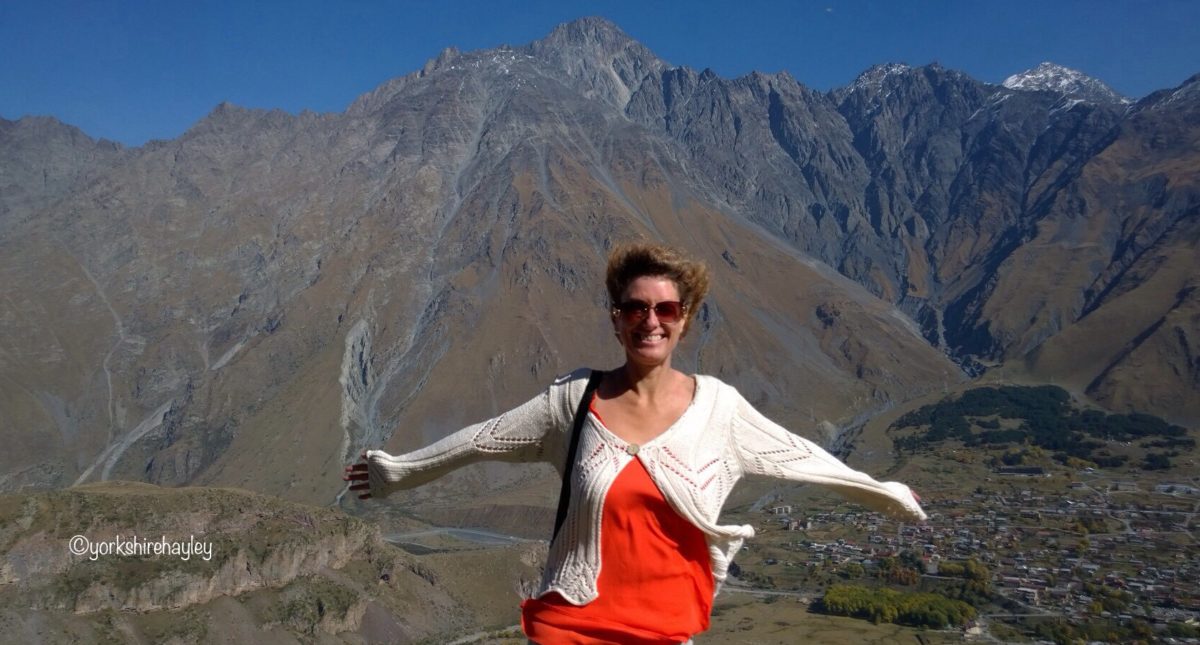
Following my day looking around the southern part of Bintan, my second day was going to be spent exploring more of the island.
The gateway to Tanjung Berakit
The room rate for my extremely comfortable hotel also included a buffet breakfast, so I went to the breakfast room to see what was on offer. As I’ve said before, I’m not a foodie and I’m extremely cautious about trying things I don’t recognise. I will generally stick to toast to be on the safe side, but in South East Asia I’m always intrigued by the little cakes they have on offer at breakfast. I don’t normally eat cake for breakfast, although I have been known to have blueberry muffins from a hotel breakfast buffet, but the bright green cakes I was faced with on the buffet this morning, I had to give them a try.
Sea gypsies inhabit this northeastern tip of Bintan
In Indonesia if you see a green sponge cake, it’s invariably a pandan chiffon cake which is flavoured with the juice from the leaves of the pandan plant. The leaf juice is green, therefore the cake is green. A chiffon cake has a lighter sponge than a traditional sponge cake and pandan tastes rather like vanilla. So it’s a essentially like eating a vanilla flavoured, green coloured, light sponge. And quite possibly the only Indonesian cuisine I ate during my time on Bintan. It’s what happens when you’re a picky vegetarian!
Looking out to sea at Tanjung Berakit
The first place we were going to this morning was Tanjung Berakit, which is over in the northeastern tip of the island not too far away from Trikora Beach.
Boats at Tanjung Berakit
It’s deceptive how big Bintan Island is. It’s much bigger than Singapore, but it’s less built up and has a smaller population. So as this was the furthest point from our starting destination it took us quite a while to drive there.
The sea gypsies village of Tanjung Berakit
There wasn’t a lot of activity there when we arrived. It was early in the morning, the population of sea gypsies that live here were presumably still fishing out at sea. I had a couple of photos of me standing in empty locations and then we moved on.
The chapel at Grotto Santa Maria
After this we were heading to Grotto Santa Maria which is close to Trikora Beach. Ahmadi had warned me it could be really bad with insects as you walked through the trees to get to the grotto, so I went armed with repellent and waterproofs to keep the mozzies off me. In actual fact there were hardly any insects at all and I was boiled in my waterproofs, I could have left them in the car.
One of the fourteen stations of the cross
From the entrance the path leading up to the church has the 14 stations of the cross along it and then you reach the grotto, a small cave with a statue of the Virgin Mary inside it. Next to the cave is a small chapel.
Grotto Santa Maria
A small Catholic community was established in Trikora in the 1960s and the Virgin Mary statue, acquired from Java by a French priest, was installed in the grotto on Bintan in the 1970s. The deceptively heavy statue weighs 250 kilos. The current larger grotto and the neighbouring chapel and the 14 stations of the cross were constructed in the last 20 years and this is now a place of pilgrimage.
Walking ankle deep in ocean where footprints disappear
It is a very peaceful location and no one else was around when I was there, but it was relatively early in the morning. If you’re in the area it is worth a visit, but I wouldn’t make a special journey there. However, it is worth making a special journey to see Trikora Beach.
My footprints on Trikora Beach
Trikora Beach on the eastern coast of Bintan is the largest beach on the island, a beautiful sand beach with very few tourists. At the southern end of Trikora Beach there are some resorts. Ahmadi explained to me that these catered to the Chinese tourists who came to Bintan whereas the Westerners all headed to the resorts at Lagoi on the island’s north shore.
Waves over the sand wash away my footprints
The stretch of Trikora Beach that Ahmadi took me to was deserted for most of the time, just one other local couple turned up briefly.
Taking a break on the beautiful, deserted Trikora Beach
Trikora Beach has a pizza place run by Italians who moved over to Bintan, unfortunately we were here too early for the pizza place to be open. It was also a Monday, so it could have also been one of the days they closed.
I spent quite a bit of time enjoying the peace on Trikora Beach
I wanted to spend some time enjoying the beach, so I decided to have a fresh coconut. What could be more tropical than drinking coconut water with a straw from a fresh coconut on the beach? I have to admit that coconut isn’t my favourite flavour, but I do enjoy coconut water which has a much milder taste than coconut flesh.
Fresh coconut water at Trikora Beach
I then took a walk along the edge of the beach, just ankle deep in the sea, where you can briefly see your footprints until the next wave comes in and washes them away. Bintan is practically on the equator, so it’s always warm there. I’m not a person who can sit around on a beach all day. After I’d had my coconut water and my walk along the seashore, I was ready to do some more exploring.
On the rickety bridge at Gurun Pasir Busung
Ahmadi had suggested I might like to go snorkelling in the afternoon, but as I can’t swim in seawater or swim very well at all, for that matter, he had to think of something else.
Pretending to ride a pretend camel in a pretend desert
He drove me right over to the opposite side of Bintan to Gurun Pasir Busung, the island’s mini desert in the west, which is actually the result of previous bauxite mining. When the mining was stopped the land was just left to nature and the result is a series of solidified sand dunes. At various spots around these solidified dunes there are tacky cardboard cut-outs of camels and suchlike for a desert inspired photograph or two.
Solidified sand dunes are a by-product of an abandoned bauxite mine
Much better for photos is the impossibly coloured blue lake, also a by-product of the bauxite mine. As the lake has all sorts of nasty stuff in it because of its mining history, you can’t go in the water, but there are some lovely spots to get photos including a sort of wooden gazebo made of logs and a heart. There’s a wooden bridge to walk across and, my personal favourite, a swing. The swing isn’t in the best location for the greatest photos, the wooden gazebo takes that honour, but I just love swings, so I was happy to sit on that for a while.
The artificial lake is a by-product of bauxite mining
There were plenty of stalls here at the exit to Busung, so I got a local refreshment, freshly pressed sugar cane juice. When it comes to drinks I’m a lot more adventurous than I am with food. I didn’t recall ever having fresh sugar cane juice before. It was very nice. I liked it better than the coconut water. But it was probably not as good for my health. I don’t know, sugar cane is a plant isn’t it? Coconut is a plant. So wouldn’t that bring them out about equal?
An ideal spot for a photo with the blue lake behind
My final tourist attraction of the day, that I was planning on doing the next day, but was told by Ahmadi would be difficult to arrange from my accommodation, was the Lagoi Safari Park and Eco Farm. Since I had paid for a driver and guide for 10 hours, it made sense to let Ahmadi take me to the safari park and then at least I would get there and not spend the whole of the next day frustrated that I couldn’t get there from my resort hotel.
Enjoying a swing at Gurun Pasir Busung
The safari park was not at all busy. In actual fact, it’s still being constructed and improved, hopefully that will mean better living conditions for the animals, but they seemed to be moving in the right direction.
The desert has more water than an average desert!
I was practically the only one there. I was taken round by a man in a golf cart and since I was the only visitor, I got to see the animals quite close up. I went in with the tortoises, got quite close to the orangutans who were having a new living area constructed and I also saw my first Komodo Dragon.
In Gurun Pasir Busung
Elephant rides were available, so I had a short elephant ride, although I was wearing a sundress today, so it wasn’t the ideal attire for riding an elephant. But I hadn’t expected to come to the safari park today. I had ridden an elephant before so I was content to have just a short ride before going to my resort hotel.
In the enclosure with a giant tortoise
At the exit there were some miniature plastic houses in the garden area, they seemed a bit of an odd addition, but good for a couple more photos before I left for the resort.
With an Indian elephant in the safari park
Ahmadi was waiting for me to take me to my accommodation, the Cassia at Lagoi Bay. It was a huge complex, a maze of buildings and corridors, quite difficult to find your room and a long walk from reception. The room itself was pleasant enough, but this was a standard resort hotel and cost twice as much per night as the hotel in the capital Tanjung Pinang.
The orangutan is having a new living area built
After I’d checked in Ahmadi picked me up to take me over to the Treasure Bay Hotel, which is part of the Lagoi Bay complex of hotels, where I could enjoy sunset on the beach and then look around the lantern park as it lit up after dark.
A Komodo dragon in the safari park
I found what looked like the base of a bed on the beach and sat on that to watch the sunset. As I was practically on the equator, the sun sets very rapidly. It was enough time to enjoy the sunset without getting bored sitting on a beach for too long. Boredom sets in very rapidly for me!
Posing at the Eco Farm
There was a small lantern park at the Treasure Bay Hotel and the silk lantern figures were all lit up at night. It was pleasant to walk around now the lanterns were lit after dark and I took a few photos of the lanterns.
A boat in the sunset at Treasure Bay
And that was the end of my tour of Bintan Island. Tomorrow I would be staying in resort all day, relaxing on the beach before I headed back to Singapore. It would be like being on a beach anywhere in the world.
Sunset at Treasure Bay
Just as a footnote, the day I spent at the resort was not for me. I wanted to get out and about and do things, not listen to music on my iPod and read a book on a sunlounger. That really isn’t my kind of holiday. I was very pleased I’d spent a couple of days exploring the entire island before I came to the resort.
The lantern park at Treasure Bay lights up after sunset
If I ever went back to Bintan, I wouldn’t bother with the resorts, I would stay in the capital and maybe visit the local markets and do more shopping. I’d go back to spend an afternoon at Trikora Beach and have a pizza and a coconut water or a sugar cane juice. But I wouldn’t venture anywhere near Lagoi again.
Figures at the lantern park at Treasure Bay
My recommendation, even if you do enjoy relaxing in resorts, get out and see a bit of the island, check out some temples, Penyengat Island and take a boat down the Snake River to see depictions of hell at the Chinese temple. You get to see what real life is like on Bintan and the locals will love seeing you out and about exploring their island. Maybe you’ll even end up being a rock star for the day!
I visited Bintan in August 2019.
I did a private tour of the Bintan Island with Ahmadi from Bintan Adventure Tour. A private taxi for 10 hours cost 800,000 Indonesian Rupees (approximately £44).
I stayed at CK Tanjung Pinang Hotel and Convention Centre in the capital Tanjung Pinang in a superior city room which costs around 630,000 Indonesian Rupees (approximately £35) including breakfast. I booked through Agoda.
I travelled to Bintan from Singapore with Majestic Fast Ferry which departs from Tanah Merah Ferry Terminal in Singapore and lands in Tanjung Pinang on Bintan Island. A one way ticket costs approximately £30 in 2022. The journey time is 1 hour and 40 minutes.
Rockstar for the day with locals on Penyengat Island
I had wanted to visit Bintan for years. Bintan is an island that belongs to Indonesia, but is easily accessible from Singapore. I love Singapore and this was my fourth visit to the country. It had been my intention to take a trip over to Bintan on one of my previous trips to Singapore and somehow I’d never quite managed to get there. So on this Singapore stopover I was determined I was going to go over to Bintan.
The entrance to 500 Lohan Temple
I had flown overnight from Perth to Singapore and from Changi Airport I headed straight to the ferry terminal to get the boat to Bintan Island. I wasn’t sure how long it would take me to get through Changi Airport and to the ferry terminal, so I had allowed myself plenty of time to get there. However, the famous Singapore efficiency was up to the usual standard, I was quickly through immigration, my bags were on the carousel almost immediately and the ferry terminal wasn’t very far from the airport by taxi. I could have got an earlier boat after all.
Some of the 500 Buddhist statues at 500 Lohan Temple
All this meant that I had a lot of time to sit and hang around at the ferry terminal. I checked in, got rid of my suitcases and then I had to clear Indonesian immigration as I would be landing in Indonesia when I got off the ferry. I had read some conflicting information about whether I needed a visa or not for Indonesia. For a visit of less than 30 days I didn’t need a visa, but you had to use certain entry points if you were travelling by sea to be exempt from the visa requirements. From what I could tell, any of the ports from Singapore on Bintan were included in these entry points, so I didn’t need a visa and that was correct. I breezed through Indonesian immigration and sat to wait for embarkation.
Indonesia’s Terracotta Warriors
I was watching one Chinese lass with her mobile taking millions of selfies. She put her hat on for some of them and then her sunspecs. I wondered why she wanted so many selfies, especially in this very drab waiting room with its plastic seats and white walls. She’d have been better waiting until she got to Bintan or at least onto the ferry when there might have actually been something to look at!
Enlightenment has brought happiness to this Buddhist
The journey time to Bintan was just under 2 hours across the South China Sea, but Indonesia was an hour behind Singapore, so it was around 10am local time when I arrived on Bintan Island.
Misery or contemplation?
I had booked a local guide with a car for 2 days to take me around the island. I had done extensive research about all the things there were to do on Bintan and we had worked out an itinerary so that I wasn’t crisscrossing the island both days. I had to wait ages for my suitcase and so I was the last person to walk down the jetty from the ferry. However, my guide, Ahmadi was there waiting for me.
A view of the temple and all its statues from the roof
I got him to take me to my hotel first so that I could drop my bags off and get changed. I had booked a room in business hotel in the capital Tanjung Pinang. The room was incredibly good value and it wasn’t busy at all. Most tourists who go to Bintan stay at one of the resort hotels in Lagoi in the north of the island. I was staying there for the other two nights, but since there were quite a lot of tourist attractions to see around the capital, it made sense to stay there. I was very impressed with the lovely room I got and I could check in immediately because it wasn’t a busy hotel.
Interior shrine at Lohan Temple
I reflected afterwards what a shame it was that people didn’t spend time on the southern part of the island. I enjoyed this region much more than the resort area in the north.
Bodhisattva guards the entrance to 500 Lohan Temple
I got changed out of my flight clothes and put my comfortable and colourful jump suit on ready to tour the island and we were ready to explore. The great thing about having a personal guide is he knows exactly where to take you and you can take as long as you want in each location. And there’s someone there to take loads of photos for you.
Banyan Tree Temple
Our first stop was 500 Lohan Temple. In this Buddhist temple 500 life size statues were lined up in the garden like Bintan’s own version of the Terracotta Army. There’s a huge statue of a Bodhisattva at the entrance and then you walk round the back into the garden where all the statues are.
The Chinese Gate marks the entrance to Lao Ya Keng religious compound
As you walked through the entrance gate there were guardian statues where I had my photo taken and then we went round to the back to see the 500 life size statues of Buddhist figures at the back. These uniformly white figures are supposed to represent those Buddhists who have gained spiritual enlightenment and insight into the nature of existence, so the fact that they reminded me of outdoor ornaments you see for sale at a garden centre meant the significance was obviously lost on me.
Sun Te Kong Temple at the religious compound
There was a huge variety of figures at the temple, one looked unnervingly cheerful while another looked downright miserable. I suppose enlightenment and insight can either be a blessing or a curse!
A tiger relief inside the temple
I walked up the steps into the temple and from here I could see the entrance of the temple from above and also got a view out over to the enclosure where the 500 figures were.
Inside Sun Te Kong Temple
As we were leaving a local woman approached my guide and spoke to him and he said that she had asked if she could have her photo taken with me. I was immediately suspicious. Why did this total stranger want her photograph taken with me? But it didn’t seem it was going to do any harm, so I said yes. After Ahmadi had taken a photo of us, I asked him why this local had wanted a photo with me. He explained that very few westerners ventured out of the Lagoi resort hotels and explored the island and that locals loved to have their photos taken with westerners who did look around Bintan beyond the resorts.
A happy Buddhist monk welcomes visitors to Lao Ya Keng
It was a holiday weekend on Bintan, so there were a lot of locals out at the various tourist sites in the south of the island and total strangers asking to have their photo taken with me became a common request throughout the rest of the day.
Buddha sitting on a lotus flower with the symbol of holy divinity and spirituality on his chest
It was actually quite exciting to be a rock star for the day. I did rather enjoy being so popular. I could see that it would be really annoying living like this permanently though. I was pleased this was just a one day novelty.
The multiple arms and heads represent the far reaching and all seeing powers of Buddha in Tibet
Next it was on to Senggarang village calling first to see the Banyan Tree Temple, a temple with a scruffy looking exterior surrounded by the branches of a banyan tree that’s grown around it. There were a few locals sitting outside the temple eating lunch, but there wasn’t anything else much to see here, so after a few photos and a glance inside the temple we made our way to Senggarang village.
The grounds of the Lao Ya Keng religious compound
At Senggarang Village is the Lao Ya Keng religious compound which contains the oldest Chinese temples on the island. There is a huge Chinese gateway right by the water that marks the entrance to the compound. I had more locals asking to have their photo taken with me there and I obliged before moving into the compound.
Senggarang stilt village is believed to be the first Chinese settlement on Bintan
The Sun Te Kong Temple is on this compound and there is a huge colourful statue of Buddha sitting on a lotus flower there. He has the symbol of holy divinity and spirituality on his chest and the symbol being left facing means it represents Buddha’s footprints.
Approaching Penyengat Island sailing on the South China Sea
On this complex there is also a Buddhist statue with multiple heads and arms which is often used in the Buddhism practiced in Tibet, which makes sense as we were at a complex of Chinese temples. The many heads and arms represent the far reaching and all seeing powers Buddha has. As you can tell, I’m no authority on Buddhism, a simple and brief explanation of what I was seeing was all that was required, so that I would have enough time to see everything on my itinerary today.
The long, colourful pier at Penyengat Island
Senggarang is a Chinese fishing village believed to be the first Chinese settlement on Bintan. It is distinctive due to the stilt houses that were built on the water’s edge by the fishermen. I had asked Ahmadi to arrange for a boat trip for me to take me over to Penyengat Island and down the Snake River to another small Chinese Temple. Ahmadi had arranged a private speed boat, just for me, for the afternoon so I could see everything that I wanted to see on this part of Bintan.
On the pier ready to explore Penyengat Island
The boat picked me up at Senggarang Village and we sailed past the stilt houses on our way to Penyengat, but we didn’t land there and so I didn’t walk along the boardwalks outside the houses which would have been nice. Maybe next time. It didn’t take us long to sail to Penyengat and we moored at the jetty so that I could tour the island.
The tomb of Queen Raja Hamidah is painted royal yellow
Penyengat Island was a lot of fun in several respects. Rather than walking around, you have the option of getting into a becak and being driven around the island in that, A becak is basically a highly decorative motorbike and sidecar and I really enjoyed riding in it.
Exploring Penyengat in a becak
Penyengat which means “stinger” gets its name from the fact that passing sailors used to get stung by insects as they passed in search of fresh water.
The ruins of the Old Stone Palace
The island was the home of the king during the last phase of the Malay kingdom and the first thing you see when you get to the island is the Grand Mosque in royal yellow. It is said that it was built using egg white to stick everything together! Egg white was apparently discovered to be a fabulously strong bonding agent. I went past the mosque in my becak and stopped for a quick photo, but I didn’t go inside.
An old tree has grown into the palace ruins
Also in royal yellow is the tomb of Queen Raja Hamidah which I looked at from the outside too. Her family members and servants are buried here with her and their headstones are all draped in the royal colour of yellow.
The ruins are almost deserted despite a lot of visitors on the island
We then went on to look at the ruins of the old stone palace and I had a brief walk around and took more photos. The ruins are part of a colonial style building. It had columns and walls, but no roof.
The Grand Mosque in royal yellow is said to be held together by egg whites
This is one of the historical sites on the island which the locals are highlighting as a reason that the island of Penyengat should go on the UNESCO World Heritage site list. I thought that Penyengat was delightful and probably deserved this accolade.
The exterior of Balai Adat Melayu Pulau museum
There was one final stop and it was one place that I did go inside while I was on Penyengat Island. Balai Adat Melayu Pulau is a museum that recreates the interior of a traditional Malay palace. I had several photos taken inside the colourful interior including on the throne which was surrounded by curtains of gold, green and red.
The interior of the museum recreates a Malay Palace
This was another place where I was inundated with requests to have my photo taken with local people, including one lady who wanted a photo with me and her young son. I felt like I was an ambassador from the United Nations! But I got much more enjoyment meeting local people inside beautiful venues like this than saying in a soulless beach resort like the majority of Western tourists.
A journey down the Snake River to visit Sungai Ular Buddhist Temple
Finally it was time to head back to the boat and as I got onto the boardwalk, there were a load of school boys who spotted me and asked if they could have their photo taken with me. I was disappointed this photo wasn’t also captured on my camera, because I was completely surrounded by beaming school boys who were absolutely thrilled to have me in the centre of their photo. That was definitely my most rock star moment of the entire day!
Sungai Ular Buddhist Temple
I still had one more trip to make in the boat, going down the Snake River to Sungai Ular Buddhist Temple. The boat took me through the mangrove swamps down the river until the Chinese Temple came into sight. Despite it seeming fairly inaccessible, there were a few worshippers there. It looked like there was a road that led here, it wasn’t just accessible by river.
Some of the very disturbing representations of what awaits you if you go to hell
The thing that made this temple unique, and particularly interesting to me, were the small paintings on the walls around the doorway just as you enter. These paintings represent the horrors and torture in hell. The paintings of Chinese figures showing what awaited evil people in hell were very disturbing, definitely the stuff of nightmares, but also strangely fascinating. I spent quite a long time looking at them. There was a lot of blood involved and quite a bit of hell fire too. Certainly no shortage of reminders of what would happen to you in the afterlife if you lived a bad life on earth.
Burn in hell!
There was a shrine outside the temple where a few worshippers came and went, I had a look at it and it certainly had a calming effect after all of those gruesome paintings in the temple. After taking a few photos of this rather more serene view, it was time to depart.
There are no shortage of extremely gruesome reminders of what will happen in the afterlife if you live a bad life on earth
But my day wasn’t over yet. We had one more temple to visit, the Vihara Avalokitesvara Graha Buddhist Temple. This temple features one of the tallest statues of the Goddess of Mercy in South East Asia. The bronze statue is almost 17 metres tall and is coated in 22 carat gold. I went inside the temple to take a look at this enormous statue and then took a look around the grounds.
The shrine at Sungai Ular Temple
The temple is located in huge grounds, this was by far the biggest compound I’d seen. The driveway leading up to the temple was very long and there were more Buddhist outdoor garden ornaments in the grounds.
Vihara Avalokitesvara Graha Buddhist Temple complex
That marked the official end to my sightseeing for today, everything I’d had on my list had been ticked off. But I still had a bit of time left with Ahmadi, so I decided to take advantage of the fact that I was staying in the capital and asked if he could take me to a shopping mall. Obviously the markets are much cheaper and supposedly give you a much more authentic experience of your local environment, but as it was around 5 o’clock in the afternoon, I doubted there would be many stalls still open. Besides, I’d had the thoroughly enjoyable experience of interacting with local people all day in parts of the island where most tourists never venture, so I think I’d had plenty of authenticity today.
This 17 metre tall bronze Buddha is coated in 22 carat gold
There were still bargains to be had in the shopping mall and local people work and shop there. I wasn’t in the tourist resort part of Bintan. I might have been in a shopping mall, but I didn’t see any other Western tourists.
Vihara Avalokitesvara Graha Buddhist Temple exterior
I’m a typical woman who loves shoes and handbags. There were some lovely handbags, but even though they were cheaper than they would have been in Europe, they were still reasonably expensive, so I passed on the handbags. I couldn’t pass on the shoes. I spent ages in a large discount shoe shop and bought two pairs of very sparkly slip ons that would fit nicely into my suitcase. After an hour or so I went back to the car and got Ahmadi to drop me off at my hotel.
One of the large statues in the grounds of the Vihara Avalokitesvara Graha Buddhist Temple
As I have already said, the hotel was a bargain and not only were the rooms very cheap, they also did inexpensive on site massages. After an overnight flight from Oz, an early boat trip over from Singapore, gaining an hour with Indonesian time and then an intensive day looking around the southern part of Bintan, a massage was just what I needed to help me relax and fall asleep so that I was refreshed in the morning, ready to explore more of the island the next day.
I visited Bintan in August 2019.
I did a private tour of the Bintan Island with Ahmadi from Bintan Adventure Tour. A private taxi for 10 hours cost 800,000 Indonesian Rupees (approximately £44).
Ahmadi arranged a private speed boat to take me to Penyengat Island and to the Sungai Ular Buddhist Temple for 800,000 Indonesian Rupees.
I stayed at CK Tanjung Pinang Hotel and Convention Centre in the capital Tanjung Pinang in a superior city room which costs around 630,000 Indonesian Rupees (approximately £35) including breakfast. I booked through Agoda.
I travelled to Bintan from Singapore with Majestic Fast Ferry which departs from Tanah Merah Ferry Terminal in Singapore and lands in Tanjung Pinang on Bintan Island. A one way ticket costs approximately £30 in 2022. The journey time is 1 hour and 40 minutes.
The green glow of the bath makes me look like the Wicked Witch of the West
I love going to spas and so when I decided to go to Lithuania, I had to incorporate a break to a spa. Druskininkai seemed to be the main spa town in the country with lots of spa hotels. After looking at the various hotels, I decided that Spa Vilnius in Druskininkai was the best place to go because it had some of the traditional Lithuanian treatments that I wouldn’t find in some of the other hotels, especially the peat mud bath. It also offered amber treatments as Baltic amber from Lithuania is world renowned.
Admiring the view from my room balcony in the freezing December air
Druskininkai was easy to get to by bus from Vilnius bus station, just a 2 hour journey and the spa was only a 5 minute walk from the bus station in Druskininkai. The bus wasn’t busy and even though we had been allocated seats, one of the other passengers kindly told me that she had asked the driver and he said we could sit anywhere and space out. It was a pleasant enough journey, even though the view from the window was hardly spectacular. The scenery was very flat and very grey on this winter December day.
Getting ready for 2022 in the park
My room wasn’t ready when I arrived, so I decided to take a walk around Druskininkai to explore. The town is easy to walk around, even though it is quite spread out. I walked past the upside down house, through the park which was decorated for Christmas, into the small square where the Christmas tree was and found the cable car that went across the river to the indoor ski centre. I didn’t have time to do that today as I had some treatments at the spa later, so I headed to back to the hotel to check in.
My deluxe room complete with bathrobes to wear in the spa
My room was ready when I got back, I had a deluxe room with a balcony which was actually a very large room consisting of a bedroom, separate living room with sofa and a kettle and fridge as well as the ensuite bathroom. I only briefly went onto the balcony, it was literally freezing in Lithuania at the moment, so it wasn’t the weather for sitting out there in my bathrobe enjoying the view with a glass of prosecco. In fact, it wasn’t a brilliant view either, a few tower blocks in the distance and bare branched trees, but I could see the river and it wasn’t the hotel’s fault that there were tower blocks close by and certainly not their fault I’d decided to visit in winter so there was no colour to the trees or the sky!
Living room part of my deluxe accommodation
My treatments this evening were an amber bath and then an amber massage. I put on my bikini and my bathrobe over the top and went to find spa reception. The spa part of the hotel is really beautiful, lots of quiet areas to rest on big sofas, loungers and chairs, in white and brown muted colours to create a relaxing atmosphere.
A quiet area in the spa to wait for my treatments
Before I had any treatments I had to have an appointment with the doctor. This is a very useful tip if you’re booking a spa break in Lithuania. If you go to a spa and have an appointment with the doctor who will approve your chosen treatment programme, it’s classed as a medical stay and is exempt from tax. If you don’t see a doctor it’s considered to be a leisure stay and you have to pay tax on it. My doctor’s appointment consisted of 15 minutes where the doctor took my blood pressure, listened to my chest and asked a few general questions about my health. She didn’t speak English so the receptionist came in with me and did the translating.
Totally relaxed in Spa Vilnius
This was another thing about Druskininkai. It’s a reasonably obscure town tucked in the southern part of Lithuania and so has very few foreign visitors. They said they rarely got any guests from England, they were mostly Lithuanian. I didn’t hear any English being spoken by the guests, I was definitely a rarity.
Jacuzzi pool in the spa
After my appointment with the doctor, I had my amber bath. There was a corridor of rooms where all the baths were and various bath treatments were offered, but I had gone for the amber bath today, followed by the amber massage because it was something traditional due to the famous Lithuanian Baltic amber. The bath was filled with warm water, the jets were turned on, I got into it and then a jug of an amber oil mixture with echinacea and motherwort was poured into the bath to soak into my skin over the next half hour while the jets massaged my body. It was a really nice feeling, I thought that it certainly did my skin some good, but then again, who wouldn’t want to lay in a bath of luxurious amber oil?
In the jacuzzi pool before my Amber Road massage
When I had finished my bath, I decided to check out the pool facilities and sauna facilities. I went in the jacuzzi first, then I had a swim in the pool. I went into the other room where there was a much larger jacuzzi pool and three saunas. The most comfortable one was the Bio Sauna at a temperature of 45 degrees and not much humidity, the other two I couldn’t stand to be in for long. The dry sauna which had a temperature of 90 degrees was too hot and the wet sauna where all the surfaces were dripping was too humid. I went intermittently into the Bio Sauna between going in the jacuzzi until it was time for me to go for my amber massage.
A cup of herbal tea is recommended after a massage
The Amber Road massage, a lymphatic drainage massage using amber oil and amber stones, was very relaxing. This was what I needed after having a flight that landed at 2am in Vilnius and then virtually no sleep before I got the bus to Druskininkai. I was tired enough to really relax into it and the massage therapists at Spa Vilnius were very good.
The Christmas tree, Santa train and post box to the North Pole in the park
At the end of the massage I went on one of the loungers in the relaxation room and enjoyed a cup of herbal tea. I was in the relaxation room on my own, so I could really relax. I wasn’t interested in going back into the pool after I’d had my tea, I was just going to go back to my room and relax in there for the rest of the evening. Tomorrow was an early start.
Some interesting Christmas decorations in the park
The beds in the Spa Vilnius hotel rooms are very comfortable, I had a really good night’s sleep. Just as well because I had an early start with a few activities crammed into my schedule before 10 o’clock.
About to post a letter to Santa
First of all I’d booked a Sonata to the Sun massage to wake me up, it took just half an hour, but it was booked for just after 8 o’clock. This massage was supposed to help you banish stress by targeting points in your body responsible for fear and anxiety. It was a lovely gentle massage and I felt relaxed at the end of it. I’m not entirely sure it had woken me up for the day, but it had certainly got my day off to a good start.
Riding in the only cable car in Lithuania
The doctor had recommended that I do the morning aqua aerobics class as well, so I dutifully took off to the swimming pool after my massage and did half an hour of aqua aerobics. Even though I didn’t speak, my blank looks when the male instructor was speaking were enough of a hint for him to realise I wasn’t Lithuanian and he spoke in English, although he demonstrated at the side of the pool what we should be doing, so I could have got by without him speaking English. I hadn’t done an aqua aerobics class for ages and I quite enjoyed it. I could certainly feel it working.
Crossing the Nemunas River
The staff had made a reservation for me to take part in the class, but there were only 3 of us in the class. Maybe it was too early in the morning or it clashed with breakfast. In fact, it did clash with breakfast, but if I was quick, the theory was I could dash off to the breakfast room before it closed at 10 o’clock. I suppose if I hadn’t turned up to the aqua aerobics class no one would have bothered chasing me up about it, despite it being the doctor’s advice, but I had half an hour to get breakfast and as long as you were there before 10, you didn’t get chased out of the breakfast room.
The forested area around Druskininkai
I was impressed with the breakfast, there was a huge amount to choose from, breads, pastries, fruit, vegetables, cheese, fruit juice, smoothies, tea. I set myself up for the day with a decent sized breakfast and then it was my intention to walk into Druskininkai, get the cable car across the river and have lunch at the place that served Arabic cheesecake before going back to the spa for the afternoon.
The ski centre can be reached by the Hoist Cableway
It was cold outside again today, so I wrapped up warm and headed into the town. I walked through the park with all the Christmas decorations in it and up to the entrance to the cable car that I’d found the previous day. Unfortunately there was a group of school children waiting there and I was told that it would take half an hour or so to get them all across to the ski centre. I bought my ticket and checked out the building next door which was a hotel and waterpark. I wouldn’t have time to use the waterpark on this visit, but I would definitely check out the waterpark if I came to stay in Druskininkai again. The waterpark was still closed, it didn’t open until later and there wasn’t really anything you could see inside, so I walked back to the park, took some photos of the Christmas tree and could see, from a distance, that the queue for the cable car appeared to have dissipated.
Ice skates hanging from the window ledge
I went back to the cable car and waited for the next ones to come back. There were 4 cable cars as part of the Druskininkai Hoist Cableway. There were 2 lines of cable and 2 cable cars for each line. The cable cars went over the river and back on the same line rather than in a continuous circuit like a lot of cable cars do and both cable cars went together. I got into one of the cable cars with another couple and it took just under 10 minutes to go across the Nemunas River to the ski centre.
In the cable car on the return journey
As we set off and left the town behind there was an expanse of woodland below. The Nemunas River crossing was almost at the end of the ride, a wide, brown river running through the woods. The descent into the ski slope station was immediately after the river.
Another view of the Nemunas River from the cableway
The couple in the same cable car as me didn’t stay to look around, they just got straight back on and went back, as did the family in the other car. They must have been tourists or just having an outing and as it was only 5 Euros return, it was a reasonable enough thing to do, especially since this was the only cable car in the whole of Lithuania.
A final view of the Christmas tree on my way back towards the spa
I decided to get off and look around. I quickly realised there was nothing much here apart from the ski centre. I was aware that there were some houses located at this side of the river, but they weren’t in sight. If there were any woodland walks you could do, I couldn’t find any signposts for them. And it was cold, I didn’t have a vast amount of time, so it wouldn’t be a good idea to go exploring today.
The upside down house is part of the Museum of Illusions
I went into the ski centre, which was very nicely decked out inside, the shops selling the skiing equipment looked like Swiss chalets against a mountain background painting. But there was nothing to do here, so I went out to the cable car station and rode back across the river into the town.
Which way is up?
One of the peculiar things in Druskininkai is the upside down house. Part of the Museum of Illusions, this is a little yellow house along the pedestrian walkway near the park with its roof on the ground. I had enough time to have a look around, I was sure that 15 minutes would be more than enough, there were only 2 rooms, one upstairs and one downstairs. I hadn’t seen anyone else going in it while I’d been in the town. I suppose once you’ve been inside, there wouldn’t really be any need to go and look at it again, it was interesting to look inside for me, but I wouldn’t go in it again if I was back in Druskininkai.
The kitchen of the upside down house is upstairs!
The lower floor is the bedroom, because this is upside down and would be the top of the house if it was the right way up. Various objects were hanging from the ceiling or stuck to the walls. I went upstairs to the combined kitchen and living room and separate bathroom. There was a lot of detail, ironing board, children’s toys, pictures on the walls. I took a lot of photos, but a couple will give you the general idea of what it’s like. It makes you look like you’re hanging upside down if you turn the photo upside down so it appears everything in the house is the right way up. It’s difficult to explain, it’s easier to look at the photos. Although the photos do something to your brain which finds it hard to compute what’s going on in them!
Inside the upside down house
I didn’t have a massage until evening, so I could go and have something to eat before I went back to the hotel without me having any issues with digestion. I had my mud bath in the early afternoon, but that would be fine. There were a few places to eat in Druskininkai, including a rather nice looking Italian restaurant, but Toli Toli had caught my eye because it had Arabic cheesecake on the menu which I’d never had before. I love cheesecake and it also had a rose flavour to it and anything that’s got a floral flavour like lavender, rose, violet or lilac is my first choice.
The staircase is also upside down
I ordered baked feta with tomato and olives and then the Arabic cheesecake and a flavoured lemonade to drink. There were several flavours of lemonade to choose from, but for me there was only one choice. Seabuckthorn lemonade. I love seabuckthorn flavour and it is very popular in the Baltic, but I’ve never really seen it anywhere else. I’ve ended up having a lot of seabuckthorn flavoured drinks in Estonia, so it was a chance for me to have it again.
Baked feta with tomato and olives with seabuckthorn lemonade
The Arabic cheesecake was not what I was expecting. It was soft cheese surrounded by sweet vermicelli pastry topped with pistachio and served in a sweet rose flavoured syrup. The cheese cut through the sweetness, but it would probably still be too sweet for someone who doesn’t like really sweet things. Luckily, I can eat really sweet things, so I enjoyed it a lot.
Arabic cheesecake in rose flavoured syrup
I then walked back to the spa hotel and quickly changed into my bikini and bathrobe and went to spa reception to report for my peat mud bath.
Peat mud baths are famous in Lithuania. I couldn’t come to a spa here and not try out this ritual. Apparently the best peat mud in Europe comes from Druskininkai so this was the ideal place to have a mud bath. According to the information, special peat generating from different plant organisms over a long period of time is used for the treatment. However, it didn’t look very enticing when I walked into the room where I found a bright green bath filled with black gunge. If I was going to get into that, it had better be good for me!
The enticing looking peat mud bath ready for me to get in
Getting into the bath was actually worse than I expected. A large amount of mud had settled to the bottom of the bath and squelched underneath me as I lowered myself down. I was then encouraged to coat my limbs with this peat mud which was supposed to detoxify and improve my metabolism. I did this, but the bath was very hot. Unfortunately, when I tried to communicate this to get a bit of cold water into the bath, the therapist misunderstood and started to put in yet more hot water! Finally, I got her to understand that I needed cold water and she put in a bit of cold water for me. The bath was still very hot, but now it was enjoyable rather than me feeling like I was melting, like the Wicked Witch of the West, who I probably looked like in this light with the green glow of the bath reflecting off my face.
The peat mud at the bottom of the bath following my 20 minute treatment
After 20 minutes it was time to get out of the mud bath. I scraped as much mud off my arms and legs as I could before I got out and then went into the shower and tried to get rid of all the mud.
I wasn’t planning to head back into the town again. I’d seen everything I needed to see. So it was another couple of hours at the swimming pool, jacuzzi and saunas and I was very good and did quite a number of lengths of the pool for the exercise, although I have to admit, it wasn’t a very long pool, not 50 metre Olympic size or anything like that. But swimming was swimming, even if it was in a small pool, which I mostly had to myself because the other guests there seemed to be in the jacuzzi, the saunas or on the loungers. When a family with children got into the pool, that was my cue to get out and go into the saunas.
The relaxation room was empty after my massage, ideal for resting in the evening
I hadn’t initially planned to have another massage when I was putting my programme together for my 2 night stay, but I was persuaded to have a “jazz massage”. I think, not unreasonably, I was expecting this to be quite a lively massage to jazz music. In fact, it had nothing to do with jazz music at all. It just meant it was a varied massage that catered to my own needs.
The massage therapist definitely had her work cut out with me. I had knots in my muscles everywhere. They were like rock. She said she would have to put some pressure on my muscles to try and ease the tension, so I agreed and actually it wasn’t too bad, but I could certainly feel her working. She was appalled at quite how tense and knotted my muscles were and as she got to another area on my back or shoulders or neck or legs and felt what a mess my muscles were, once again she was amazed that almost every muscle in my body was rock solid.
Seabuckthorn – the taste of the Baltic
She wondered if I’d be there the next day, so she could have another go, I told her that I wasn’t. So she had to be satisfied with the hour she spent trying to loosen my muscles off, which had her working quite hard to try and get any sort of pliability in them. Although it most definitely wasn’t a relaxing massage, it was certainly effective and beneficial. And that was the last treatment I had at Spa Vilnius in Druskininkai.
Druskininkai in December
The next day I was leaving for an early bus and as breakfast didn’t start until 8am and my bus left at 8.30, I had no time to eat before I left. The reception staff were very concerned about this and offered to get me a tea, but I declined. It was far too much of a nuisance dragging my suitcase up the hill to the bus station with my rucksack on my back without also having to try and carry a cup of tea in a cardboard cup. They offered to get me a box of something to eat, so I said if they wanted to get me a couple of croissants, that would be very kind. So while I settled my bill, one of the other staff ran to the breakfast room and filled a box with pastries for me, which I could fit in my rucksack so I didn’t have to carry them separately.
The town of Druskininkai in Lithuania is just a few miles from the border with Belarus
I had been very happy with my stay at Spa Vilnius. The booking procedure which I had done via email had been a bit of a drawn out process, but I did get the programme and the room that I wanted. My room was large and very comfortable and in better weather the balcony would have been lovely to sit on with a glass of fizz. The pool and saunas were pleasant and the therapies I had were extremely good. I enjoyed all the massages and both of the baths I had. Breakfast was good and there was the additional gesture of the staff making sure I got some breakfast to take away with me to eat because I was leaving early, I really had no complaints at all. It was also really good value, less than 400 Euros for 2 nights accommodation with breakfast, use of the spa facilities, aqua aerobics and all those treatments I’d had. In comparison to a spa break in England, the price was phenomenal, so I would happily stay at Spa Vilnius again.
The town of Druskininkai from above
On the other hand, Druskininkai was full of spa hotels. There was another one I had considered when I’d been looking online and I rather liked the look of the one with the waterpark attached next to the cable car station that I discovered when I was there. So I’m not sure whether I would go back to Spa Vilnius because I know how good it is or try out another spa because I want to try something different. Who knows, I may never return to Druskininkai. But I would thoroughly recommend it and definitely wouldn’t turn down the opportunity to go again if it presented itself to me.
I visited Druskininkai in December 2021.
I stayed at Spa Vilnius in Druskininkai in a junior deluxe room with a balcony. A 2 night stay with breakfast booked directly through the hotel website cost €198 which included use of pool and saunas and a consultation with a doctor to qualify as a medical stay.
The mud and amber baths are approximately 20 minutes and cost €12 each. Massages start from €31 . The Spa Vilnius website has a full list of spa treatments. You can request your treatments at the time of booking and the reservation staff will incorporate these into your stay.
The Druskininkai Hoist Cableway is the only cable car in Lithuania. It costs €5 return. The journey time in the cable car is around 8 minutes each way.
The upside down house is part of the Museum of Illusions. Entrance is €2.
I had Arabian cheesecake and seabuckthorn lemonade at Toli Toli, a cafe in Druskininkai town centre.
I travelled to Druskininkai from Vilnius by bus. The journey time is approximately 2 hours. A return ticket from Vilnius bus station cost €22.60. I booked online through autobusubilietai
I flew to Vilnius from Doncaster Sheffield (Robin Hood) Airport with Wizz Air. The flight cost £75 return.
I was so looking forward to going to Purnululu National Park. I had planned my whole trip to Australia around my visit to see the black and orange beehive domes of the Bungle Bungle ranges, this was somewhere I really wanted to see.
Sadly, my time in the Kimberley was hardly a roaring success. Problem after problem after problem was what I encountered initially. A series of bungles you might say.
The emblem of Purnululu, the famous black and orange striped domes
Thankfully I’m a generally positive person and looking back, I remember the highlights with satisfaction and don’t think too much about the things that went wrong. Any experiences at the time that were tainted by problems along the way have disappeared into the recesses of my memory. But I have recorded them all, just as a reminder.
One of the baobab trees on the way to Purnululu National Park
The problems started when I arrived in Kununurra on a Sunday morning and just about everything was shut. I had no car, it was horrendously hot, so walking very far wasn’t really possible. All in all it was a bit of a dead day. But the next day I was going into Purnululu National Park which I was really looking forward to.
You can see how wide the tree trunks are with me in front of one
I picked up the hire car, nowhere near as nice as the one I’d had in South Australia or in Darwin either, for that matter. It was a Mitsubishi Pajero that had done over 50,000 kilometres and had no USB port for charging my phone which was a nuisance. It also wasn’t very clean. I hadn’t had such a great car in Alice Springs with Thrifty either, maybe they were a company best avoided in the future.
Two baobab trees on the outskirts of Kununurra
I drove through the Kimberley and saw the baobab trees that Madagascar is famous for, but they do have them here in Australia too. No one quite knows how they got to Australia, but you see quite a lot of them dotted in amongst the other trees. In August the ones out by the road didn’t have any leaves on them, the ones in Kununurra had obviously been watered so they did have leaves on them. But by the side of the road, in the harsh, rainless dry season, there was no water to keep the leaves alive.
There’s still some distance to drive once you get to the park entrance
I didn’t know what the road to the Bungles would be like, I didn’t think it could be any worse than the Oodnadatta Track. And actually, it didn’t seem quite as bad. The 4WD on this Mitsubishi seemed better than on the Toyota, I didn’t seem to be sliding on the gravel like I had been on the Oodnadatta Track when it was really corrugated. I could keep up a steady 40kph which I was happy with because this road, unlike the Oodnadatta Track, was not a straight road. There were lots of twists and turns and ups and downs on this road. I could tell where the water crossings would be at the end of the wet season,. But it took me less than 2 hours to drive it, so I was happy with that.
A short hike into Cathedral Gorge
I stopped at the Visitor Centre to pay my National Park fee and noticed when I went to the toilet it said to close the toilet lid because frogs liked to go swimming in the toilet and frogs attracted snakes who liked to eat them. After that, all the time I was in the Kimberley I looked in the toilet for frogs and snakes before I used it.
In Cathedral Gorge
I then drove towards the wilderness lodge, first driving to the airfield to try and organise a longer helicopter flight the following day. They had a call come in while I was there for a 42 minute flight at 11am, so I jumped onto that one. Little did I know.
Walking amongst the domes
Then I went to the wilderness lodge and stayed there for the rest of the afternoon. I was very impressed with the friendly staff at the lodge, they all knew everyone’s name and it was very professional. I was shown to my accommodation for the next 3 nights. It was a tent. It was a large tent, it was a posh tent and it had a shower, basin and toilet in it and a floor. But it was still a tent. But if you came to the Bungles there wasn’t too much choice. You were either in a posh tent or a normal tent. So I’d chosen a posh tent. I was told there were blankets in the basket if I needed them because it got cold at night. I definitely needed them.
Further along the Domes walk
It was very cold at night. As I was on my own I could fold the blankets in half so I had a double blanket, so I had four layers of blankets on, but I was still cold. That was what really let the place down. Paying over $1000 for 3 nights I shouldn’t be freezing in bed at night. Even the really basic places I’d stayed had a heater in them. They needed to invest in heating the tents when people were paying that sort of money to stay there. You shouldn’t be sleeping really badly because you were so cold. The last night in particular was really bad and it was also bad at dinner because we were eating outdoors. I had a cardigan on and was shivering and had to get myself a cup of tea to try and warm up, because there were a lot of people at dinner every night and service tended to be on the slow side. Not great when you’re sitting there shivering.
A few trails in the southern part of the park take you amongst the black and orange striped domes
The wilderness lodge was very like an upmarket safari camp. Not that I’ve been on safari or stayed at a safari camp in Africa, but from what I’ve seen from brochures and the telly of upmarket safari camps, it looked like one. And I spoke to a lady who was originally from South Africa and had recently been on safari and she said that it was exactly like the safari camps in the Kruger.
Holes in the rock
People were generally very friendly who stayed at the lodge, they sat the groups together and then put the independent travellers on tables together. I didn’t talk too much at dinner at first, but I was sitting opposite Kristina and Marcus who were German. Kristina was originally from Hamburg and wanted to move back there, but Marcus was a Bavarian and a teacher in Munich and very much into the Bavarian way of life. I asked if they lived in the city and Kristina said they did, so I asked if they knew the Rattlesnake Saloon. And they did! They went there regularly to watch the bands and said a lot of people who lived in Munich didn’t know about it because it was in the suburbs. Marcus said originally there was nothing much in that area, just the Rattlesnake and then about 12 years ago they started building houses there and completely surrounded it. He asked me how I knew about it and I said I’d been trying to find country music in Germany and it came up on my search so I went there and had a fabulous night. I never expected to be in one of the remotest parts of Australia and be talking to someone about the marvellous Rattlesnake Saloon in Munich.
A view of the extent of the iconic beehive domes from an open door helicopter flight
The dinner service was very slow that night. Pork was on the menu and the Austrian group staying at the lodge had all decided they wouldn’t eat it and so the chef had to make them all chicken instead. We were waiting ages.
A river running through the dome landscape
Next day was my helicopter ride, but since it wasn’t until 11, I had time to go to the southern part of the park and walk the Domes trail and Cathedral Gorge. Maybe even the Piccaninny Gorge viewpoint.
A view of the domes from above
I did manage to do the Domes and Cathedral Gorge walks. This was what the Bungles were famed for, the black and orange striped domes in the southern part of the park. I loved walking amongst the domes and Cathedral Gorge lived up to its name with towering rocks surrounding you. I took a few photos and then headed off. I didn’t have enough time to do Piccaninny.
You can really make out the layers of the rock as you fly overhead
It was only just half past nine when I passed the airstrip, I wasn’t supposed to be there until 10.30, far too early to go and wait. If only I’d known. I went back to the lodge, had a quick drink and then went to the airstrip getting there just before half past ten. Then I was told, the people booked on the 11 o’clock flight had turned up early and so they’d already left! I got a lot of excuses about why they hadn’t waited, but basically it came down to the staff not looking in the diary, always assuming that people are travelling in couples and forgetting about single travellers. He said I could go on the 12.30 flight which meant me waiting around for 2 hours. If I hadn’t really wanted to do the flight I would have told them to get stuffed. Unfortunately, although this company has such disregard for its single customers they were the only ones who had a commission to fly in the park. So if I wanted to go on the flight, I would have to go with them.
A close up of the domes from the helicopter flight
I’d really got my heart set on it. I’d been emailing them since March to try and book the flight. And because of the mistake I was offered 10% off. So I decided to go. But I still wasn’t happy. When the people who had arrived early got off the helicopter, the bloke said g’day to me. I just glowered at him!
Purnululu National Park from an open door helicopter flight
The 12.30 flight didn’t go early either, so I was waiting a full 2 hours to get into the air. However, it was an amazing flight. Seeing the domes from the air and the gorges throughout the park was spectacular. They cover a huge area and if you’ve come all this way and driven lots of dirt roads to get here, the helicopter flight is a must, despite being run by people who don’t care about single travellers. If you’re in a couple you’ll be fine, if you’re a single traveller, good luck!
The Northern part of the National Park is very different to the iconic beehive domes of the South
The brilliant thing about these helicopter flights is that the helicopters don’t have doors on them, so you’ve got no glass obscuring the side view. I got the front seat as well, I don’t know whether that was to placate me after leaving me behind or whether I would have got the front seat anyway. I tried to look on it positively, I got my wonderful aerial view of the Bungles and I got 10% off.
The start of the trail into Mini Palms Gorge
That afternoon I drove to the Northern part of the park to hike the Mini Palms Gorge Trail. This is supposed to be the most difficult trail in the park and it was the pick of the northern walks. There are palm trees in the Mini Palms Gorge. It took about 2 hours as the literature advised, but I did take some time taking photos. I set off at 2 o’clock, it wasn’t really a good idea to set off much later than that even though it was still very hot at this hour.
A mini palm!
The lady in the Visitor Centre had said that you were in and out of shade on this hike. More out than in for the most part, until you got to the Gorge itself. The first part of the hike was easy, flat and in the sun. The second part of the hike takes you into the gorge where you see the palm trees and also have to battle your way through a narrowing Gorge to get to the end of the trail.
Boulders block the trail in some places
There are lots of big boulders on this hike and you do have to squeeze through gaps between boulders and climb over rocks to follow the trail. So I squeezed through gaps between the boulders and climbed over the rocks wondering where these steps were that had replaced the most difficult part of the trail that the lady at the visitor centre had told me about. Right at the end, it turned out. But it was quite challenging to get to these steps. However, it was a magical place and the few people in a tour group were just leaving so I then had the place to myself.
Some larger palms in the gorge
It was shaded and the palms were beautifully silhouetted against the sky. After a few minutes I started to make my way back and I could have sworn I heard someone rustling about in the undergrowth. I couldn’t see a thing. It might just have been a kangaroo, but I was thinking that I was all on my own here, probably the last person of the day and what if a backpacker murderer was lurking in the trees. I wasn’t a backpacker, but that might not stop him. It was spooky. The eerie noises continued. I just kept walking until I couldn’t hear them anymore. Maybe it was my own fault for dismissing the Aboriginal superstitions as nonsense, maybe the spirits were getting their own back by scaring me a bit. They succeeded!
Reaching the end of the trail as daylight starts to fade
I had the clambering and squeezing to do again on my way back and I was relieved to get into the sunny and exposed part of the trail and out of the spooky rocks and trees. It had cooled down quite a bit by now as well. I did pass one bloke who was walking into the gorge as I was coming out. He was leaving it a bit late. I spent quite a bit of time with him the following day hiking to Whip Snake Gorge and found out that he finished the walk in the dark!
Some taller mini palms
It was 4 o’clock when I got back to the car and so I decided I should drive back to the wilderness lodge. I didn’t really want to be driving these roads in the dark if I could help it. It wasn’t so good at dinner without the couple from Munich who had now departed and I tried not to dwell too much on the helicopter leaving me behind. The helicopter flight itself was great, seeing the Bungles from the air from the front seat of a helicopter with the doors off. And I’d enjoyed the walks I’d done today, the first sight of the domes as I hiked through them and the mini palms gorge walk even though I was squeezing through tight gaps and spooked by noises coming from the bushes!
Another view from Mini Palms Gorge
The next day as I’d got the helicopter flight out of the way the day before I could concentrate on hiking for the whole day with no time constraints other than making sure I got my hiking done before it was dark and I set off to the southern part of the park to walk to Piccaninny Gorge lookout, the Window and Whip Snake Gorge which I wrote about in my previous post.
Inside Echidna Chasm
In the afternoon after a brief rest at the lodge I went back to the Northern part of the park to hike the Echidna Chasm Trail. I’d been to similar places in the States, the hike was initially walking along a dry creek bed until you got to a narrow canyon. It changes colour when the sunlight hits it in the late morning or early afternoon, but I was there a lot later than that so I missed it. It was okay. Certainly a long way down my list of best hikes in the park. That was probably because I’d not come at the optimum time to see the colour change when the sun was in the right position. But coming at this time I did have the place to myself.
The narrow canyon on the Echidna Chasm hike
It was so cold at the lodge that evening. The meals were all outdoors and it was a lot colder that night than it had been on other nights. The service was always very slow and sitting there shivering throughout the meal was not fun. It was just as bad in my tented cabin that night, even with two blankets doubled up over me I could not get warm. When they’re charging that amount of money, they really need to make sure that they have adequate heaters if people have to eat outdoors and they need to install heaters in the tented cabins as well. Being cold all night under the equivalent of four blankets was ridiculous. You don’t expect northern Australia to be so cold at night, even in winter, but this was far enough inland to have those extreme drops in temperature.
All alone in Echidna Chasm at the end of another day in Purnululu National Park
The final day I decided that I would do the Homestead Valley Hike that I hadn’t initially planned on doing, it was the only one I hadn’t done in the park now and I wanted to do them all. I noticed Joe’s camper was there who I hiked to Whip Snake Gorge with , so he must have been on the hike, he’d said he was going to do it.
Twice a day the sunlight is perfect to change the colour of the rocks – but not when I went!
The Homestead Valley Hike didn’t take very long. It was a fairly easy hike with a few steps, but generally it was quite fast walking. There were some aboriginal rock artworks located in the area, but there was no access to them. I presumed that the area where it said there was no access beyond that point was where the rock art was. Joe was at the end of the hike, we chatted a while and took a few photos and then hiked back together.
You cannot hike beyond this point as the Aboriginal rock art here is sacred
Joe and I chatted about the hikes in the park. We’d both done them all, but Joe said he didn’t think many people were serious hikers like us. I didn’t actually think I was that much of a serious hiker, I only did day hikes, not long distance overnight hikes, but since most people seemed to walk the bare minimum, in comparison I suppose I am a serious hiker. I liked doing some of the hikes, and I was certainly keen to do less popular ones so that I didn’t meet a lot of people. In the Bungles there weren’t generally huge groups because the road into the park couldn’t accommodate big coaches, but even a group of 20 was too many for me. But you didn’t have to walk very far before you had the whole place to yourself, because even the tour groups didn’t walk that far.
On the Homestead Valley hike
The road out of the park seemed a lot worse than I remembered when I’d driven in. The whole time I’d been in the Bungles the graders had been out grading the road within the National Park, but they didn’t seem to have graded the road into the park. It wasn’t in great condition and it seemed to be slower going than when I’d driven in. I remember noticing when I drove into the park, how much better the road was than the ones I’d driven in South Australia, like the Oodnadatta Track and the Painted Desert Road, but driving out, I seemed to be driving more slowly, there seemed to be more twists and turns and ups and downs. It seemed to take forever. I kept looking at the mileage and counting the kilometres down and finally I was at the main road.
View from Kungkalanyi Lookout on the drive out of the National Park
The drive back to Kununurra was fine. I was fascinated by the Baobab trees and stopped to take photos several times. Some of the trees were absolute monsters. It was quiet on the roads and no one much as stopping, so again, I had the places to myself and could set up the gorilla grip to take a few photos with me in them. I headed back towards the town.
A baobab tree with a double trunk
As I said at the beginning of the post, I’d longed to see the Bungles for years. I’d built my Australian itinerary around going into Purnululu National Park. And while the incident with the helicopter trip had been annoying and I’d been cold at night, those memories do fade and all in all I was happy with my decision to go there. The drive into the park had been an adventure, there were some amazing hikes and the view from the air was fabulous. Kakadu National Park was the highlight of my Australian trip, but the Bungles weren’t far behind and I would recommend fitting Purnululu National Park in if you can. You just need to bear in mind, it’s remote, it’s expensive, it’s a journey to get there and has extremes of temperature. It can get very hot in the middle of the day, but it’s freezing at night!
I travelled to Purnululu National Park in August 2019.
The Domes Trail and Cathedral Gorge hikes are in the southern part of Purnululu National Park. The Mini Palms Gorge Trail, Echidna Chasm Trail and Homestead Valley hikes are in the northern part of Purnululu National Park. These are all relatively short hikes that can be done in a maximum of a couple of hours.
It takes approximately 5 hours to drive from Kununurra to the Purnululu National Park entrance. Approximately 3 hours is on the main tarmac road from Kununurra, the last 2 hours or so is on the 4WD road to the park entrance. You must have a high clearance 4WD vehicle to drive on this road.
Entrance fee to Purnululu National Park for vehicles payable at the Visitor Centre is currently $13AUD.
I stayed in the Bungle Bungle Wilderness Lodge run by APT. I stayed in a superior tented cabin with ensuite facilities. A 3 night package of bed, breakfast and evening meal was $342AUD per night (approximately £185 per night). This was a discounted rate available for a stay of 3 nights or more. I booked directly with APT.
My ensuite superior tented cabin
I did my open door helicopter flight with Helispirit. I did the Ultimate Bungle Bungle flight which is 42 minutes and currently costs $589AUD per person (approximately £335).
An excellent practical guide for the Kimberley Region is available from Kimberley Australia written by Birgit Bradtke. There is a free mini guide, but I also purchased the more in depth online guide that gives you all the information you need to self-drive to Purnululu National Park.
I rented my 4WD car from Thrifty at Kununurra Airport. A 4 day rental cost $760AUD (approximately £420).
I flew to Kununurra from Darwin with Air North. The flight takes one hour. I paid £100 for my outbound flight and £145 for my return flight. I booked my flights with Budget Air.
Read about my favourite hike in Purnululu National Park
As I recall my time in Oz in 2019, my favourite hike was the one to Whip Snake Gorge in Purnululu National Park, otherwise known as the Bungle Bungle.
I would thoroughly recommend this wonderful hike, but it isn’t exactly easily accessible. Purnululu National Park is tucked away in the northeastern corner of Western Australia, a really long way from everywhere.
The vast Purnululu National Park in the remote Kimberley region
The Kimberley is the least visited part of Australia, full of 4 wheel drive roads that are inaccessible for parts of the year due to flooding. On some of the roads in this region you will always have sections where your vehicle will need a snorkel to enable you to drive through deep water, others like the road to the Bungles is dry in the height of winter, like when I travelled there in August.
I considered driving to the Bungles from Darwin, but a drive of over 1000km which would take over 12 hours was not appealing. Instead I flew to Kununurra and rented a 4 wheel drive vehicle from there specifically to drive into Purnululu National Park.
At the entrance to Purnululu National Park after a 5 hour drive
It takes just under 3 hours to drive from Kununurra to the turn off for the Bungles, on a well maintained tarmac road where you can maintain a normal speed of around 100 kilometres an hour.
Then I reached the road to the Bungles. It was a 4WD only road and you have to drive for quite a distance on it before you even get to the boundary of the National Park itself. The Visitor Centre is 53km along the road. I didn’t know what the road to the Bungles would be like, but I had already driven a large section of the Oodnadatta Track in South Australis, so I didn’t think it could be any worse than that, which had been in really bad condition. And actually, it didn’t seem quite as bad. I didn’t seem to be sliding on the gravel like I had been on the Oodnadatta Track in the sections where it was really corrugated. I could keep up a steady 40 kilometres per hour which I was happy with because this road, unlike the Oodnadatta Track, was not a straight road. There were lots of twists and turns and ups and downs on this road, I could tell where the water crossings would be at the end of the wet season. But it took me less than 2 hours to drive it, so I was happy with that.
Piccaninny Gorge Lookout
I stayed at the Bungle Bungle Wilderness Lodge. In my next post I’ll go into detail about it and some of my other experiences in Purnululu National Park, but for this post I’m just going to concentrate on detailing my favourite hike.
I had managed to do the other things I wanted to do in the Bungles so far, so I could concentrate on hiking for the whole day with no time constraints other than making sure I got my hiking done before it was dark.
A close up of the black and orange domes from the gorge lookout
I set off to the southern part of the park to walk to Piccaninny Gorge lookout, the Window and maybe Whip Snake Gorge. The entire return hike to Whip Snake Gorge is 10km and will take half a day. I had initially intended to do all three hikes, but I wasn’t sure once I started, it was very hot and I didn’t know whether I had the energy in this heat.
The southern part of Purnululu National Park is where you find the famous black and orange striped beehive domes that the park is famed for. The walk along Piccaninny Creek takes you deeper into these domes and further away from the crowds. The further you walk, the less people you see.
Beehive shaped karst sandstones domes are what made Purnululu world famous
First of all I did the turn off for Piccaninny Gorge which is close to the start of the hike. I knew from experience that if I didn’t do it on the way out, chances were on the way back I would feel too tired and miss it. Always do the diversions on the way out. A couple of German tourists who were with a group rather than self-driving were going to the Window first and then changed their minds and decided to do the Piccaninny lookout first instead as they were on a time limit. I passed the bloke who had been walking into the mini palms gorge as I had been walking out the day before. His name was Joe and he said he was doing the hike to Whip Snake Gorge today.
It was a fabulous view from the Piccaninny lookout over the beehive domes, but I only stayed there for a few minutes and then moved on. It’s a good place to be at sunset, but then you have to walk back in the dark, so I contented myself with the view in the morning.
Piccaninny Creek bed is dry in the Australian winter
I headed back to Piccaninny Creek. You can walk a huge distance along Piccaninny Creek on an overnight hike, but you need a permit to go any further than the Whip Snake Gorge turn off. I wasn’t interested in doing this hike, I was contented with a half day hike where I could see the famous domes without the crowds, but didn’t have to camp out overnight. I had also seen the extent of the domes from the air, so this would be enough for me.
Sand, gravel and bedrock form the route along Piccaninny Creek
At the start of the Creek you’re mostly walking along flat rocks and some sand. On some of the rocks you have to be careful as in some places they are separated and there’s a huge gap between them with a long drop down to the creek bed. In most cases the rocks are locked together so you don’t have to worry too much. As you get further along the Creek, the flat rocks are much less frequent and you’re crunching along a creek bed full of gravel, or rather very large stones which are difficult to walk on. It’s very hard going on the legs and you have to watch where you’re walking all the time because it’s so uneven. So I didn’t have any compulsion to do the full hike along Piccaninny Creek.
The creek floods in summer and huge holes in the rock have been caused by the powerful water
I did really enjoy hopping over the huge gaps in the rock, which had obviously been caused by water erosion. The creek floods in the wet season and flash floods are common, so it’s not surprising the rock had eroded and you get huge holes in the creek bed. I found it fascinating, the scenery at ground level was as amazing for me as the rock and domes above. This was another reason I loved this hike so much, even if it did make for a more challenging walk.
The Window is well worth a detour from Piccaninny Creek
The next turn off you can do along Piccaninny Creek is the Window, which was exactly what the name suggested, a large hole in one of the rocks that looked like a window. You really shouldn’t miss this short detour, I loved it there. Joe was at the Window when I arrived and he asked if I’d like a photo and persuaded me to climb into the Window, he said it wasn’t that difficult. I was pleased I took his advice because he got a couple of fabulous photos of me in the Window.
Joe was going to walk to Whip Snake Gorge after that and I decided that I would too. It was hot, but what was I going to do for the rest of the day? This is what I’d come to the Bungles for.
Finding my own route along the creek with the magnificent domes beside me
Most people don’t hike to Whip Snake Gorge. It’s just too far. You need a permit to hike Piccaninny Creek and it is an overnight hike, so most people just do the first lookout, a few more adventurous ones walk to the Window and then turn round, so there are relatively few tourists that hike the full 5km to reach Whip Snake Gorge. In one way it’s a shame, it’s a lovely hike and a beautiful peaceful place. In another way it’s wonderful, because it means it’s usually empty and you have it all to yourself.
I don’t think that will change. Unlike the top of Gunlom Falls in Kakadu where they are making the path easier, there’s no way of doing anything to Whip Snake Gorge. You can’t make it any shorter than it already is, you have to follow the dry creek to the turn off, so you can’t do anything with the hiking trail, so it is likely to remain a hike that few tourists who visit the Bungles will complete. However, after I’d made all the effort to drive to the Bungles and the fact was, I would probably never return, it seemed sensible to do all the hikes I possibly could.
You have to hop over the gaps in the bedrock and find a route that avoids the biggest gaps
The path to the gorge was fine, a bit up and down and part of it walking along another dry creek. The characteristic domes were there without the crowds of the domes hike and hike to Cathedral Gorge. Once we got to the end of the gorge, it was quiet, peaceful and empty.
The gorge walls tower above you and so this is one place where you do get some shade and it’s a bit cooler. The hike along Piccaninny Creek has no shade and even in August when I was here, in the middle of the Australian winter, during the day it was very hot.
Hiking into Whip Snake Gorge
I ended up walking with Joe for a good bit of the hike and then we took a few photos and sat in the gorge for a while enjoying the peace and quiet. He set off before me, I took a few extra minutes to rest, enjoying the gorge and the beehive domes as I headed back to Piccaninny Creek, but we ended up catching each other up again and walking all the way back to the car park together. It was a very enjoyable day.
At the end of the 5km hike in Whip Snake Gorge
Joe and I chatted about the hikes in the park. We’d both done them all, but Joe said he didn’t think many people were serious hikers like us. I didn’t actually think I was that much of a serious hiker, I only did day hikes, not long distance overnight hikes, but since most people seemed to walk the bare minimum, in comparison I suppose I am a serious hiker. I liked doing some of the hikes, and I was certainly keen to do less popular ones so that I didn’t meet a lot of people. In the Bungles there weren’t generally huge groups because the road into the park couldn’t accommodate big coaches, but even a group of 20 was too many for me. But you didn’t have to walk very far before you had the whole place to yourself, because even the tour groups didn’t generally walk that far.
Towering blocks in Whip Snake Gorge, but thankfully no whip snakes in sight!
I was so pleased I decided to do the hike. In the National Park visitor centre, the lady there had told me that the Mini Palms Gorge often turned out to be people’s favourite walk in the National Park. Not mine. Mine was definitely Whip Snake Gorge. It wasn’t so much Whip Snake Gorge itself that I loved so much. It was the whole hike along Piccaninny Creek, to the lookout and then the Window and along the creek bed with the huge holes in the rock that you had to hop over. There was no defined trail along the creek, you just find your own route and have to make sure you don’t get trapped where the gap is too big to jump across. It all added to the excitement.
Hiking out of Whip Snake Gorge back to Piccaninny Creek
My recommendation is if you make the effort to go to Purnululu National Park, because it is an effort to get there, and especially if you’re not doing the overnight hike along Piccaninny Creek, definitely make sure you set aside a half day to do the 10km return hike into Whip Snake Gorge. You get to experience walking along the creek, the fabulous detours to the lookout and the Window and the peaceful gorge itself. It’s very rewarding and hopefully you’ll love it just as much as I did.
I travelled to Purnululu National Park in August 2019.
The Whip Snake Gorge hike is in the southern part of Purnululu National Park. If you hike all the way into the gorge along Piccaninny Creek, the distance is 10km return from the car park and will take about half a day.
It takes approximately 5 hours to drive from Kununurra to the Purnululu National Park entrance. Approximately 3 hours is on the main tarmac road from Kununurra, the last 2 hours or so is on the 4WD road to the park entrance. You must have a high clearance 4WD vehicle to drive on this road.
Entrance fee to Purnululu National Park for vehicles payable at the Visitor Centre is currently $13AUD.
I stayed in the Bungle Bungle Wilderness Lodge run by APT. I stayed in a superior tented cabin with ensuite facilities. A 3 night package of bed, breakfast and evening meal was $342AUD per night (approximately £185 per night). This was a discounted rate available for a stay of 3 nights or more. I booked directly with APT.
My ensuite superior tented cabin
An excellent practical guide for the Kimberley Region is available from Kimberley Australia written by Birgit Bradtke. There is a free mini guide, but I also purchased the more in depth online guide that gives you all the information you need to self-drive to Purnululu National Park.
I rented my 4WD car from Thrifty at Kununurra Airport. A 4 day rental cost $760AUD (approximately £420).
I flew to Kununurra from Darwin with Air North. The flight takes one hour. I paid £100 for my outbound flight and £145 for my return flight. I booked my flights with Budget Air.
Read about the rest of my time in Purnululu National Park
Crocodile on Yellow Water Billabong yawning at daybreak
On Day 3 in Kakadu I was moving on to Cooinda, so on my way there I was going to the Nourlangie area. Here you find rock art, a lookout and the Anbangbang Billabong. What a terrific name.
Rock art featuring Namarrgon, the Lightning Man, the white figure in the top right corner and his wife, Barrginj the other white figure on the rock
I started by walking around the rock art sites. It was quite busy at the rock art sites, although hardly bus loads crowded. It was just annoying to have so many people about. I’d got used to having plenty of peace and quiet in Australia. The art sites were impressive. According to Aboriginal law you couldn’t alter previous rock art, but you were allowed to paint over it.
Nabulwinjbulwinj – an dangerous spirit who eats females after striking them with a yam
I loved the depictions of the kangaroos and lizards and there were also some figures including the elaborate lightning man, Namarrgon. He was pictured with his wife, Barrginj and they brought lightning to the area, which was very important for Kakadu. Lightning is one of the distinct seasons in Kakadu, it created natural bush fires that were needed to regulate the land. There was also a depiction of the evil Nabulwinjbulwinj, a spirit who ate females.
The hunter has caught a kangaroo and is attempting to lasso another one
The kangaroos in the rock art were fabulous, there was one picture of a big kangaroo and another depicted a kangaroo hunt where the hunter has caught one kangaroo and has it behind him with the kangaroo’s paws tied so it can’t escape and the hunter is attempting to lasso another kangaroo ahead who is desperately trying to escape.
A big kangaroo
I walked to the highest spot to look out around the park and again was impressed by how beautiful it was. A lot of people come here and look at the rock art and then move on, so consequently there were very few people on the hike round to the other side of the rock to see the view across the plain.
View from the hike around Nourlangie
I then drove down the road to Anbangbang Billabong and the lookout. It was getting hot now and it said the climb to the lookout was going to take 40 minutes. It sounded like it was quite a steep climb, so I decided to hike around the Anbangbang Billabong first.
The Nourlangie area is quiet when you move away from the rock art
The Anbangbang Billabong was 2.5km in circumference. It was a completely flat path. However, I was very nervous about crocodiles. The warnings were not to get too close to the water because estuarine crocodiles were likely to be in the billabong and to be vigilant when the path went closer to the water! Was this actually safe? Or was I about to become a crocodile’s dinner? I assumed that if it really was that dangerous they wouldn’t allow you to hike around the billabong at all. So I decided to brave it for an hour and take my chances and hope I wasn’t unlucky today.
Hiking around the rock in the Nourlangie area which features Aboriginal Rock Art
I didn’t see any crocodiles, but the chances of me spotting any were remote anyway. To begin with, they’re really well camouflaged, they’re virtually invisible in the water. And as well as that I’m rubbish at spotting wildlife! Thankfully the crocodiles didn’t see me either!
The wonderfully named Anbangbang Billabong
There was a bit of bird life as I started out my hike, but when I got around to the other side of the billabong I was in for a treat. Firstly there was a jabiru which is a big stork. When I first saw one on the Corroboree Billabong I thought what a wonderful bird it was. Now I was seeing another one. The only way to tell the sex of a jabiru is by its eyes. A male has black eyes, a female has yellow eyes. I wasn’t close enough to this one to be able to see the colour of its eyes! And I wasn’t getting any closer either, it was in the water where crocodiles could be. Crocodiles generally don’t bother with birds as they are hard to digest, although if they’re hungry enough they will eat them. I would certainly be easier for a crocodile to digest, so I stayed on the path as I tried to get some good photos of the jabiru.
A jabiru is a type of stork found in the wetlands of northern Australia
However, as I walked further along I saw a mob of emus. I have checked, mob is the correct collective noun for emus. I didn’t even know that they had emus this far north, so it was quite a thrill to see them in the wild. They were quite happy to walk around grazing, so I got some excellent photos of them. After I’d got enough photos and watched them for long enough I continued my hike around the billabong and my trepidation about the crocodiles re-emerged. I was so pleased when I finally saw the path back to the car park.
A mob of emus at Anbangbang Billabong
I was so hot now and needed to cool off, so I drove slowly to the lookout car park with the air conditioning on to try and cool down before I attempted this uphill hike to the lookout.
You’re further away from the water in some parts of the trail more than others
There had been no need for me to worry. This was a very short hike and it wasn’t a difficult and steep hike either, certainly nothing like the one at Ubirr which is what I was expecting. It was a pleasant view, but it wasn’t as spectacular as some I’d seen in Kakadu. It was time for me to go to my hotel.
The end of the circuit around Anbangbang Billabong
When I got to Cooinda, there’d been a mistake with the booking. They’d got me in a glamping tent. That wasn’t what I’d signed up for. I’d booked a standard room with a queen bed. I took a look at the “glamping tent”. It was a tent. It had a nicer bed in it than the other places I’d stayed, but it was still a tent. I’d still have to blunder outside in the middle of the night with a torch searching for the toilets. They said they had a queen room as well if I’d like to look at that and upgrade. I went back to reception and said I’d have the room. I told the assistant manager, I’d had enough of tents. I think he could tell I wasn’t impressed. £125 for the night to sleep in a tent where I had to search for the toilets with a torch in the middle of the night. I don’t think so!
View from Nourlangie Lookout
That evening I just needed to relax. It seemed to be getting hotter and more humid, so I got some wine during happy hour and ate celery and cream cheese and just enjoyed being in a nice hotel room. I certainly couldn’t have faced another night in a tent. When I went to the glamping tent which had a comfortable bed but nothing else, I couldn’t even see where the toilet and shower block was from there. I could just imagine me stumbling around outside with a torch in the middle of the night desperately looking for the toilet block.
A wading spoonbill
Next morning I was going on the Yellow Water Billabong cruise. I’d done so many boat trips I was wondering if this might be one too many, but it was a brilliant trip. It’s difficult to say what the best one was, they all had their merits, but I think this one did have the edge. We saw so much wildlife and Rachel from Texas who was our guide was very enthusiastic when she saw anything.
Sunrise over Yellow Water Billabong
We saw two jabirus, a male and a female, some herons that are usually very shy and fly off quickly, an anhinga – a snake necked darter bird, spoonbills and, of course, lots of crocodiles.
Anhinga, the snake necked darter in a tree on Yellow Water Billabong
The first crocodile we saw, when she opened her mouth was actually yawning, even though when you show people photos you have to pretend that she’s ready to snap. Apparently it takes a lot of effort for crocodiles to open their mouths, so that’s when they’re at the most dangerous and ready to strike. A crocodile with a half open mouth can be deadly. We got really close to the crocodiles and saw a couple of big males.
An estuarine crocodile just waking up
Like I never tire of seeing bears in Canada, I never got tired of seeing crocodiles. These are the animals people come to the Top End to see. There are no cuddly koalas up here, no wombats and I didn’t see many kangaroos either. So the crocodiles are the icons of the Top End Outback and what everyone wants to see up close. And when you see them up close they are huge. It’s difficult to see when they’re in the water, but when they’re out of the water and especially if they’re making the effort to jump up you can see they have absolutely enormous bodies.
When you see a crocodile from this angle you can appreciate their size – they are huge!
Rachel, our guide, tended to use aboriginal names where she could and always referred to the crocodiles as ginga which is the local aboriginal name for the estuarine crocodiles. We saw a crocodile chomping on what was apparently a file snake, although I couldn’t tell what she was eating, which I was actually quite grateful for. These snakes live in the water and aren’t poisonous but they are quite big. The Aboriginals eat them. They catch them and then kill them by biting their heads off. That will probably give me nightmares for weeks. And possibly you too. You’re welcome.
An estuarine crocodile rests on the bank
In the distance was also a herd of feral water buffalo. They are not native to the area, they were introduced to supply meat to remote northern settlements and have spread across the northern floodplain. They were all but eliminated from Kakadu National Park by the end of the 20th century, but are now back in the park in huge numbers causing a lot of damage to the floodplain.
Feral water buffalo graze beyond the water lilies
All in all it was a fabulous cruise. I had some breakfast and then I headed back out to Yellow Water to do some hiking. However, the hiking trails appeared to have been fenced off, all I could do was a short walk on an elevated metal walkway and back again. I wasn’t that bothered. It really was very hot and I was getting quite disenchanted doing long distance walks in 35 degrees with no shade.
Water lily baby!
Instead I went to the cultural centre which was really interesting and gave a lot more information about the local Aboriginals. There are lots of different aboriginal tribes all over Australia, they even had them in Tasmania because much like the native Americans who walked across the Bering Land Bridge, Tasmania was connected to Australia at one point and the Aborigines were in Australia at that time. The ones who were in Tasmania and then got cut off when Tasmania became an island.
An estuarine crocodile swims very close to our boat on the morning hunt
Most people associate aborigines with the Northern Territory and particularly the Tropical North which seems to be their homeland.
Yellow Water Billabong
The tribes here use the didgeridoo because the trees they use to make them grow in this region. They don’t hollow out the trees, they’re already hollow when they make the didgeridoo. It is an instrument of the tribes in the Tropical North. If you go to the Red Centre of Australia, anyone playing a didgeridoo would usually be white, the Aborigines there don’t play it, it’s not their instrument, the trees they use to make it don’t grow there. In fact, in the Red Centre, they don’t have many trees at all!
Pandanus tree
One thing I did do at the cultural centre was make a bangle out of pandanus tree with an old Aboriginal lady, Violet. She’d started them off and I just decorated mine with different coloured fibres from the tree which had been dyed naturally using local plants. I ended up with a bangle of yellow, orange and purple. It was special because I’d sat with Violet and some other tourists, including a few children and made a bangle out of traditional materials. It’s not something I would normally buy or wear, looking at it, you might even say it looks quite tatty. But I sat in Kakadu National Park with an Aboriginal lady and threaded myself a bangle. That made it special.
An estuarine crocodile mostly submerged laying in wait for its prey
And now it was time for me to leave Kakadu National Park for my next adventure to the Katherine Gorge. Kakadu was very special and will always remain my favourite place on this trip to Oz. Anyone who tells you not to go, ignore them. But do yourself a favour and don’t just come here on a day trip from Darwin. Instead spend a few days here to soak up the atmosphere and appreciate the beauty of the largest National Park in Australia.
I travelled to the Top End of the Northern Territory in early August 2019.
I took the sunrise Yellow Water Cruise which departed from Cooinda Lodge. The tour costs $100AUD. I booked through Kakadu Tourism an indigeneous owned group offering tours, cultural experiences and accommodation.
I visited the Warradjan Culture Centre before leaving Kakadu which is located just a few kilometres from Cooinda Lodge.
I stayed at Cooinda Lodge which is managed by the Accor Group. A night in a deluxe room cost me around £150. There was a mistake in my booking, so I paid a reduced upgrade fee for my room. You can book a room direct with Accor or through the Kakadu National Park website. It is also on several hotel booking websites.
You need to buy a pass to enter Kakadu National Park. The pass is valid for 7 days and costs $25AUD in the Dry Season. You can buy the pass online from the Parks Australia website.
I drove to Kakadu National Park from Darwin. I rented a car from Bargain Car Rentals in Darwin. I booked this through Tourism Top End who have special deals with several car hire agencies in Darwin including offering unlimited kilometres which is rare in the Northern Territory. Please note that driving hire cars on unpaved roads without a 4WD vehicle is not permitted.
On the walls of St Catherine’s Fort with Tenby Castle behind me
With the UK government’s ridiculous foreign travel policy appearing to have no end in sight, even with a high vaccination and low death rate from Covid, holding out for an overseas trip had been depressing me. Every time I’ve thought I might be able to escape to somewhere in Europe or that one of my tours might go ahead, the government just put another obstacle in the way.
View towards Tenby Castle from the North Beach
I had been doing temporary work for a consultant psychiatrist since December and hadn’t had any time off since Christmas. Even then, due to lockdowns and cold weather, I couldn’t go anywhere. The last time I had had a few day trips out in the Yorkshire Dales was in September and now I desperately needed a holiday.
A huge rock on the North Beach – you can walk around it at low tide
The UK was finally opening up domestically from mid May. Scotland looked a bit dodgy as the devolved government there always took a more cautious approach, so I decided to shelve my plans to visit Sutherland and the Orkneys for the time being and I’d been somewhere in every English county. That just left looking west to Wales. I have travelled in Wales a few times. I’ve been to North Wales numerous times on tour as well as taking a couple of short breaks in that area. I’d also been to mid Wales once taking in Hay-on-Wye and the Brecon Beacons. However, I’d never been to South Wales and more specifically to Pembrokeshire. This seemed an ideal opportunity to explore that area.
The colourful buildings along Tenby seafront
I was well aware that a lot of people were holidaying domestically this year, either because they were worried about catching Covid or, in my case, that they were worried about the government’s ever changing foreign travel policy that could mean having to find a flight home at short notice to avoid quarantine and booking numerous Covid tests despite being double jabbed. No thank you! The downside of the huge demand for domestic accommodation was that the prices had gone up. I was desperate to get away but not desperate enough to pay thousands of pounds for a week in Tenby which could go towards my next overseas trip, which I was hoping might go ahead at the end of the year.
Tenby North Beach on my first evening
June has always been my favourite month to travel, but my search for accommodation in Tenby was fruitless, there was nothing available in June at all. I decided to take it back a couple of weeks, so I would still be in the bracket of lockdown eased and tourist attractions open and my luck was in. I found a fairly inexpensive guesthouse a 10 minute walk from the seafront and town centre with breakfast and free parking. A 10 minute walk into town was a small price to pay for the convenience of free parking. One click and I was booked. My mood instantly lifted. I was going to spend the last week of May in Pembrokeshire.
The ruins of Tenby Castle keep
I arrived in Tenby at 6 o’clock on Sunday evening. I was very pleased with my room at Hammonds Park Guesthouse. It was the only room available, so I booked it, but it was a large room with a four poster bed and a separate sofa. I had a bath as well as a shower in my bathroom. And a sea view! I took a few photos of my room before it became a mess with my things all over. Then decided that I needed to have a wander round after driving for around 6 hours, I was going to explore Tenby.
View of the castle and the bandstand from St Catherine’s Island
I followed the road down the hill that led to Tenby North Beach. It was a sight I was going to become very familiar with over the next week. At the bottom of the hill is Tenby North Beach. It was low tide so I went down to the beach and had a walk along it. There was a big rock on the beach which is actually an island at high tide, although I wasn’t aware of how far the tide came in at this stage as this was my first time in Tenby.
No entry into Tenby Castle keep!
I was struck by what a colourful town Tenby was, with all the different coloured houses close to the seafront. It was like St John’s in Newfoundland. I took quite a few photos of the coloured buildings, the view of Tenby Castle from the beach and then went into the town. The town was a reasonable size and there were lots of restaurants throughout the town, all of them open now. It looked like there was a very good choice of places to eat out. I hadn’t intended to eat out all week, but it was looking a much more attractive proposition now there seemed to be so many places with good menus around. I hadn’t been on holiday for 15 months, it would be nice if I could go and eat out in the evening.
St Catherine’s Island and St Catherine’s Fort viewed from Tenby Castle
Tenby has a town wall and several town gates which you see as you walk around the town. There are plenty of archways and there are even some restaurants that are set into the town walls. After wandering around for a few hours and getting to know the layout of the town, I went back to my guesthouse ready for the next day.
There isn’t a lot of Tenby Castle left – this is it!
This afternoon I was expecting my friend, Alan, who has featured in one or two of my other posts, most notably the Pingo Trail in Norfolk, to arrive in Tenby to join me exploring Pembrokeshire for a few days. He was planning to arrive just before 2pm to check into his bed and breakfast, so I decided to further explore Tenby that morning.
Tenby’s huge South Beach with ominous cloud overhead
I walked down the hill to the North Beach and then skirted round by the harbour and made my way onto Tenby South Beach. The South Beach is much longer than the North Beach. I made my way down some very slippery steps to get access to the beach and then started to walk further south. There were morning showers expected, some heavier than others, so I didn’t walk too far along the beach as the clouds looked pretty ominous, then made my way back.
One of the entrance gates in Tenby’s town wall
There’s a huge island on the South Beach called St Catherine’s Island and it has a fort on top of it. St Catherine’s is an island at high tide, but at low tide you can walk to it. At low tide you can practically walk around St Catherine’s Island and there are some caves under the island. I had a short walk into the caves but I didn’t stay in them for long. They were a bit dark and wet, as you might expect from sea caves!
A walk on South Beach at sunset
The timing of the tides this week meant that the island was accessible from the beach and you could go and have a look around the fort. I decided not to do that today, I would wait until Wednesday morning and then Alan could come with me.
St Catherine’s Island and Fort at sunset
I then made my way up to have a look at Tenby Castle. I say castle, there’s not much of the castle left now, just one small tower that presumably would have originally been part of the keep. I took photos of the castle and the view from the castle. I was interested to see that at low tide a tractor went onto the beach and pushed a walkway out into the sea that acted as a boat dock so that people could get on and off the boats that sailed over to Caldey Island.
A view over to Caldey Island with a beautiful pink sky at sunset
On Wednesday morning at low tide we walked onto the South Beach and made our way to St Catherine’s Island to visit the fort. St Catherine’s Fort was built in 1867 during the Napoleonic Wars as one of the coastal fortifications although it was never used in any of the Napoleonic conflicts.
Walking across the metal bridge on St Catherine’s Island to reach the fort
It was sold in 1907 and subsequently sold on to the wealthy Windsor-Richards family who had made their fortune in iron and steel. Whilst in the ownership of this rich family, the fort was decorated like a stately home with carpets and tapestries, huge fireplaces and hunting trophies. The house was sold as part of the estate of one of the Windsor-Richards family in 1940 and then sold to a Tenby businessman in 1962 who turned the fort into a zoo in the late 1960s. In 1979 all the zoo animals were moved to other locations and the fort was then left derelict. So that’s a brief history of the island and the fort as it is now.
Another view of the metal bridge on St Catherine’s Island from the top of the metal staircase, but still a bit further to go before I reach the drawbridge
Enter the St Catherine’s Island and Fort Team, a group of volunteers who decided to take over this derelict fort and try and clean it up for visitors to enjoy. The entrance fee is a very modest £5 which all goes towards the upkeep of the island and it is well worth supporting this project. The volunteers are very enthusiastic, knowledgeable and passionate about this little tidal island and its fort and have done what they can to make the experience of visiting the island an immensely enjoyable one. I have to admit, much to my surprise, this was one of my highlights, not only of Tenby, but of all of the places I visited during my time in Pembrokeshire. It was a fantastic way to spend an hour or so.
St Catherine’s Fort was never used during the Napoleonic Wars as intended
The island is at the mercy of the tides, so if it’s high tide in the middle of the day, the island is inaccessible and is closed. Luckily, this week, it was low tide in the middle of the day, so we went to check it out mid morning. There was a volunteer waiting at the bottom of the steps that had been cut into the rock to take our money and answer any questions, including about Wally the Walrus, who had been quite the celebrity in Tenby recently, a young male walrus who had swum down from Greenland and seemed to like Tenby. He had been causing havoc trying to get into lifeboats or blocking the boat slipway, but everyone in Tenby loved to see him. He had now gone to Padstow which I was very disappointed to hear. I would have loved to see a walrus in the wild. Especially Wally who had made quite a name for himself in Tenby with his antics.
St Catherine’s Island is cut off at high tide
We climbed the steps cut into the rock and reached a wire bridge that linked two parts of the island so you could get to the fort. I crossed the bridge and had several photos taken on it with the beach below, as the bridge was made entirely of wire including the piece you walked across. Once across the bridge there was a view from every direction including towards the castle, the South Beach, the North Beach, Caldey Island and up to the fort itself.
On the drawbridge before entering the fort through the impressive doorway
The fort was open and had a drawbridge and an impressive door to get inside. Let me warn you, the volunteers have not managed to restore the fort to its glory days of tapestries and hunting trophies. You can only see one floor and it all looks quite damp, but the volunteers have made such an effort to give visitors a good experience. There are two thrones as you go inside and a table with a crown and a tiara on them, so the volunteer at the fort entrance came in and volunteered to take a photo of us sitting resplendently on the thrones, Alan wearing the crown and me wearing the tiara.
The Queen and King of the Castle!
There wasn’t a huge amount to see, but the volunteers have put together a 20 minute slideshow that tells you all about the history of the island and the fort, including why it was built and what subsequently happened to it, up to it being abandoned after being Tenby Zoo, but with some random amusing slides thrown in to keep your interest. There was a mock up of what the island looked like during the Jurassic Age with dinosaurs drawn in and the photo credit went to Terry Dactil…
View of St Catherine’s Island from the end of Tenby South Beach
There were also some photos of the appalling state the fort was in when the volunteers took over to try and clean it up. It had been a paradise for vandals and graffiti artists and rubbish and rubble was everywhere when the volunteers came in. The volunteers were keen to carry on with their work and expand the clean up and hopefully open up the upper level, but it was a slow process and they only had visitor entrance fee money to pay for this. It is never going to look like the inside of a stately home again, but I would thoroughly recommend you invest £5 and an hour of your time to check out the fort and support its restoration. I loved it. A real highlight of Tenby.
Wally the Walrus immortalised in glass!
I had a couple of things to do before I left Tenby. Firstly I had to go to the glass shop. I love glassware and have items from all over the world. The glass workshop in Tenby had been producing glass figures of Wally the Walrus and since I hadn’t been fortunate enough to see him here I decided I would buy a glass figure of him which would help me remember my holiday in Tenby and the holiday where I almost got to see a walrus! I couldn’t resist the miniature glass teapot in the glass shop, so that came home with me as well.
These tourists were obviously very happy to be in Tenby!
I was also determined to walk the length of the South Beach before I departed. I ended my holiday in Pembrokeshire as I started it, on my own and whereas last Sunday evening I had walked along the North Beach, this Friday evening I walked along the South Beach. The South Beach in Tenby is huge. The tide was out far enough for me to be able to walk the entire length until it reached its natural end.
Taken from the end of South Beach, Tenby is just visible in the distance which gives an idea of how big this beach is!
The tide was coming in now, I wasn’t going to be able to walk right up to St Catherine’s Island to come off the South Beach, but I had plenty of time to get off the beach from the ramp near the fish restaurant and back into town before heading to my guesthouse. It was a pleasant, relaxing, relatively peaceful walk and now I felt I’d done everything Tenby had to offer.
Paddle boarders on North Beach at high tide on my last night in Tenby
Tenby had been a good choice as a holiday destination, an attractive seaside town with plenty to do, good beaches, some nice places to eat and lots of places to visit in the vicinity. It’s a long way from anywhere, so if you do visit, make sure you stay for a few days to make the most of it, you won’t want to be making this journey too often, but it is definitely worth 5 days of your time.
My beautiful, miniature glass teapot to add to my other souvenir glassware at home
I travelled to Tenby in May 2021.
It is free to visit the exterior of Tenby Castle ruins.
St Catherine’s Fort is £5 to enter and is open when St Catherine’s Island is accessible at low tide. All entrance fees go towards further restoration of the fortress.
I bought my glassware from Gift of Glass in the town centre. All items in the shop are handmade in the glassblowing workshop in Tenby.
I stayed at Hammonds Park Guesthouse in Tenby, a 10 minute walk from the town centre with free parking and breakfast included. A large double room with a four poster bed and sofa and bathroom with bath and separate shower and a sea view cost approximately £55 per night. I booked through Expedia.
I’m somewhere on a beach, sipping something strong
Caldey Island is an island off the coast of Tenby and easily accessible from the mainland by boat. I had seen it on the Travel Show years ago and it had stuck in my mind. When I first decided to go to Tenby I didn’t know whether Caldey Island would warrant a visit, I wasn’t sure how much there would be to do there. However, after doing some research, it seemed that Caldey Island was definitely worth a day trip, especially if it was a nice day.
View across to Caldey Island from the mainland
Thursday had the best weather forecast for the week, sunny, warm, little chance of rain, so that seemed to be the ideal day to go. There were several options for Caldey Island. There were plenty of companies that offered boats from Tenby where you could sail around the island on a boat tour with commentary, but not land on the island, but there was also one company that offered a boat transfer to Caldey Island, you landed there and spent as long exploring the island as you wanted and then came back in your own time. And this is what I chose to do.
A tractor tows a walkway out to the boat so passengers can board on Tenby South Beach at low tide
As we were leaving from Tenby, going back to Tenby and the cars were going to be parked up all day, a day on Caldey Island was also the ideal opportunity to have a picnic on the beach with a bottle of wine. So with a rucksack full of wine, cheese and French bread, we went to the harbour to buy a ticket for the boat across to the island.
My arrival on Caldey Island
As the tide was out, we were going to be leaving from Tenby South Beach. The tractor was on the beach with the walkway attached so that passengers could get onto the boat. It was a pleasant 20 minute ride across to Caldey Island. We landed right next to the one public beach on the island and where we would have our picnic later and set off to explore.
A puffin and a squirrel carved onto a bench, a place to rest before you walk into the village
Caldey Island has a working monastery where monks make chocolate and perfumes and sell them in shops on the island. As well as this there is a lighthouse and a few hiking trails across the island. My plan had been to walk the perimeter of the island, but this isn’t actually possible, some of the land is out of bounds and you have to stick to the designated hiking trails, but these do cover a good portion of the island and took up several hours of the day.
Caldey Island Abbey is still home to about 20 Cistercian monks
We started out by walking from the boat dock to the village where there were several shops, a post office and the huge abbey. As with so many things on this trip, in TBC (Time Before Covid) it was possible to do a tour of part of the abbey, which is still home to around 20 Cistercian monks, but it was completely closed up now, which was disappointing. Instead we pressed on towards the lighthouse.
View across to the Old Priory
There is a turning before you get to the lighthouse to the Old Priory which is now in ruins. We had a brief look around the ruins and the attached St Illtyd’s Church with its leaning spire and then discovered the chocolate factory behind. It was relatively early in the day, so we only had to wait a few minutes for a couple to come out before we went inside. They made milk, plain and white chocolate as well as fudge and you could smell the chocolate as soon as you went inside as they were busy making some that day. After a purchase and a chat to the lady in the shop who recommended that we do the longer coastal walk from the lighthouse which takes you around the northeastern coastline of the island, we headed up to the lighthouse.
St Illtyd’s Church with its leaning spire
The lighthouse on the north side of the island was closed to the public. The lighthouse was the last to be powered by acetylene gas until it was modernised in November 1997 and is now monitored and controlled from a centre in Harwich at the opposite side of Great Britain.
The interior of St Illtyd’s Church
We continued on the only reasonably long hiking trail on Caldey Island. It follows the northeastern quarter of the island’s coastline with a certain amount of elevation gain and then cuts back overland to the Old Priory. This shore of the island is very dramatic and rugged with high cliffs that fell straight into the sea. As we walked around the northeastern edge of Caldey Island the scenery got more impressive with a mist adding a certain mysterious element to the tall cliffs and waves crashing against the rocks below. There is no option to continue following the perimeter of the island, it’s completely blocked off and the beach, which is illustrated on the map, has no public access. The southeastern part of Caldey Island is completely off limits.
Caldey Island lighthouse was the last lighthouse to be powered by acetylene gas until modernisation in November 1997
However, we had had a reasonable walk along this hiking trail and after reaching the Old Priory again we were fairly close to the village. It was approaching lunchtime, so this seemed to be an appropriate time to head down to the beach where the boat had docked, find a quiet spot and enjoy some bread, cheese and wine.
The wild coastline of the northeastern part of Caldey Island
The beach along the southern shore of Caldey Island is fairly large, so we were able to find a spot for ourselves to sit down, enjoy the view back over to Tenby on the mainland and relax with an alcoholic lunch. It was a beautiful and sunny day, so it was ideal for a picnic. We opened our bottle of wine and sat sipping Chardonnay and ate French crusty bread and the Welsh Caerphilly cheese I’d bought yesterday.
The sheer cliffs make the sea inaccessible on this part of the island
There were lots of people queuing to take the boat back to Tenby, but no boats appeared for the whole time we were eating our picnic, which seemed rather strange, but we didn’t think carefully enough about to realise there was a problem. We later discovered that the tractor that was used for passengers to embark at low tide had broken down, so there was no way of getting people back to the mainland, they just had to wait for the tide to come in so that the boat could dock at the jetty. That is something to bear in mind if you do go over to Caldey Island for the day. As well as the last crossing back to the mainland being at around 5pm, if there are any problems at low tide, you could have a bit of a wait. By the time we were ready to go back to Tenby later in the afternoon, the tide was high enough for the boats to dock again, but we still had a bit of a wait as the queue went down.
The mist rolled in as I walked along the rugged clifftops
However, after our picnic, we headed back to the village and decided to do a bit more walking, this time in the western part of the island that we hadn’t explored yet.
The only accessible beach on Caldey Island where the boats from Tenby come in to land
Most people who go over to Caldey Island don’t seem to venture very far. Most seem to hang around the beach and the village, a few will walk to the lighthouse and even fewer will do the northeastern coast walk that we had done that morning.
The small Church of St David’s is a short walk from the abbey
It appeared that not many people bothered exploring the western area of Caldey either. This fairly short route takes you closer to the abbey, which was when I discovered it was closed because of Covid, and around to the small Church of St David’s.
The Tree of Life window represents the natural, the spiritual and the divine
This is only a very small church, but it is open so you can have a look inside and see the two famous stained glass windows, the fish window and the tree of life window. Both were designed by monk, Theodore Baily in around 1922. The three branches on the Tree of Life represent the natural, the spiritual and the divine.
The famous fish window on the north wall of the chancel in St David’s Church
From there you can take the short woodland walk to the viewpoint across to the Gower Peninsula. This Bay is known as Paul Jones Bay named after the 18th century pirate who supposedly hid his treasure somewhere near this spot. I didn’t find it! You get a beautiful view over to the distant Gower Peninsula from this lookout. It’s a pretty deserted location, we certainly didn’t see many people bothering to explore this part of the island, but it’s a short distance from the abbey, it’s not a long walk and it’s one of only two circular walks on the island, so if you’ve made the effort to come across to the island and disembark the boat, I’d recommend this hiking trail, as well as the longer one around the northeastern quarter of Caldey.
On a clear day you can see across to the Gower Peninsula from Paul Jones Bay which is named after a pirate
And now we really had seen everything on Caldey, so short of walking around again, we headed back to the beach to wait for the boat to take us back to the mainland. Once the monastery is open again when the Covid restrictions are removed, there will be even more to do, so it’s well worth a day of your time if you’re having a holiday in Tenby. However, it wouldn’t be pleasant in the rain as there isn’t a lot of shelter and the visibility would be so poor you wouldn’t be able to see anything from the viewpoints, so make sure you choose a sunny day for your visit.
I travelled to Tenby in May 2021.
Information on Caldey Island including a map, can be found on its website.
Caldey Island is a 20 minute boat ride from Tenby. Return tickets cost £14. The island is open from Monday to Saturday from May to September. Caldey Island is closed on Sunday. Tickets are available from the harbour. Embarcation point depends on the tide, you will be informed of this when you purchase your ticket. Advance reservations are not required.
I stayed at Hammonds Park Guesthouse in Tenby, a 10 minute walk from the town centre with free parking and breakfast included. A large double room with a four poster bed and sofa and bathroom with bath and separate shower and a sea view cost approximately £55 per night. I booked through Expedia.
On the hill above St Davids Cathedral and the Bishop’s Palace
One of the things on my to do list in Pembrokeshire was to visit the tiny city of St Davids in the far southwest corner of the county. The city has a famous cathedral, hence its city status, and the ruins of the Bishop’s Palace next door.
View of St Davids Cathedral from the gatehouse
The restrictions had lifted enough for me to visit these attractions now, although it was stressed on the websites that you needed to book tickets in advance to be allowed entry. It was free entrance to St David’s Cathedral, but you still needed to reserve tickets. I had been checking the website since the previous week and there was always plenty of availability so it wasn’t necessary to book days in advance. My breakfast was a fairly leisurely and late one, so I set off just before 10am to take the approximately one hour journey to St Davids. I had 45 minutes to look around the cathedral and then was booked into the Bishop’s Palace.
The cathedral gave city status to this settlement in the south west corner of Wales
The drive to St David’s from Tenby is beautiful especially if you take the coastal route and drive over the bridge at Pembroke Dock. There was no time to stop for photos on the drive to St Davids, but I spotted a sign for a picnic area close by so a photo stop on the way back would be possible.
The approach to St Davids Cathedral
The most spectacular part of the drive was easily the approach to Newgale, it was a real wow moment seeing this part of the coastline from a distance. This was definitely going to be a stop on the way back. It looked very wild and dramatic.
Entrance to St Davids Cathedral
I satisfied myself with the view for now and pressed on to my destination which was now just 8 miles away. The city of St Davids looked quite busy driving through the streets, lots of people and shops and cars. However, there was a car park more suitable for visitors to the cathedral and bishop’s palace, which are next to each other, so it was easier to drive through the commercial centre and park up there.
The altar in St Davids Cathedral
It was just before 11am when I arrived, so I had a little time to have a look around the outside of St Davids Cathedral before my allocated entrance time. You can walk around the cathedral, but you can also walk up the hill to the gatehouse which is the sole survivor of the four gates that connected the medieval wall that originally surrounded the cathedral. From this elevated position you get a good view of the cathedral which is particularly useful for photos. After taking in the view from the gatehouse, it was my allocated time to go inside the cathedral.
The choir in St Davids Cathedral
St Davids Cathedral was built on the site of the burial place of St David who died on 1 March 589. Pilgrims flocked to his shrine here during the Middle Ages, the base of which is in the cathedral now and incorporated into a new shrine. This is right next to the most famous tomb in the cathedral, that of Edmund Tudor, the father of Henry VII who became king at the conclusion of the Wars of the Roses.
The magnificent interior of St Davids Cathedral
The cathedral has the usual impressive choir and stained glass windows, but I was most impressed by the huge cathedral organ that had some massive pipes that reached from floor to ceiling. They were particularly noticeable because these pipes were bright red. But I was amazed at the size of them. I am aware that church organs have a staggering number of pipes that range in size from barely visible to absolutely enormous, but I don’t think I had ever seen any as big as these before. I think this was possibly because I’d never really noticed them when I’d walked around other cathedrals, but these bright red pipes, surrounding a doorway, with a big sign next to them explaining exactly what they were, made them hard to miss.
The huge red organ pipes are difficult to miss as they surround the doorway
It took less than 45 minutes to wander around the interior of the cathedral. I believe that in TBC (Time Before Covid) it was possible to climb the cathedral tower, but this was not an option today. It was a pity. Galloping up to the top of church towers is one of my favourite things to do. On the other hand, it was a fairly standard tower as far as church towers go, not a unique lantern like at Ely Cathedral or the twisted spire of St Mary and All Saints in Chesterfield. So I wasn’t bitterly disappointed. If it had been available, it would have been nice to run up the steps to the top, as it was, I was ready to go and look around the Bishop’s Palace instead.
This window in the Bishop’s Palace is a perfect frame for St Davids Cathedral
When I first read about the Bishop’s Palace at St Davids, I assumed it was like Bishopthorpe Palace in York, which is the current residence of the Archbishop of York and not generally open to the public.
A distant view of the Bishop’s Palace
The Bishop’s Palace of St Davids is a ruin. When the Pope decreed that two pilgrimages to St Davids was the equivalent to one pilgrimage to Rome, Bishop of St Davids became the most coveted ecclesiastical role in Wales. Pilgrims flocked to this corner of south west Wales to visit the shrine of St David in the newly constructed cathedral.
The Bishop’s Palace is two storeys built around a quadrangle
The bishop’s residence was no match for the cathedral’s grandeur until the arrival of Bishop Henry de Gower in the 14th century who spent 20 years transforming a structure, which was apparently only fit for servants and animals at that time, into a show palace. The newly constructed Great Hall was where feasts were held and where Bishop Henry would welcome the more distinguished pilgrims. 200 years later, the Reformation reduced the magnificent Bishop’s Palace, like so many other spectacular medieval buildings, to ruins. And this is what you can visit today.
At the entrance to the Bishop’s Palace
The Bishop’s Palace website was very clear in stating that if you didn’t book your ticket in advance online, you would not be able to enter. As with the cathedral, there was plenty of availability even on the day before, although I visited in the last week of May, just a week after more Covid restrictions had been lifted. It is possible that as the summer progresses and the crowds increase it may be necessary to book a little further in advance. However, when I arrived at the entrance, it was actually pretty relaxed. I could walk straight in because I had my ticket at the ready on my phone, but some people had turned up without a ticket and were told that they could go into the ticket office and purchase one there and then as it wasn’t particularly busy. The Bishop’s Palace is right next door to St Davids Cathedral, but only a small percentage of cathedral visitors appeared to be bothering to look around the ruins of the Bishop’s Palace.
The Great Hall of the Bishop’s Palace was built for Bishop Henry de Gower
The Bishop’s Palace ruins can be seen in around 45 minutes. There is an upper and lower floor. There was just one part of the upper level ruins that was inaccessible as they were being stabilised, otherwise there was a logical order to walk around the ruins starting on the lower level on one side, then ascending to the upper level and staying on the upper level round to the other side of the ruins and finally seeing the lower level ruins on that side. There were plenty of opportunities to take some wonderful photos, some of the windows acted as a frame to St David’s Cathedral behind and the impressive architecture of the Great Hall was still evident despite there being no roof. You could see from the main wall of the Great Hall with its large entrance archway and intricate window above that are still intact what a magnificent building this would have been in its heyday.
One of the upper rooms in the Bishop’s Palace
After taking a few final photos of the Bishop’s Palace inside and then from a distance as I made my way back to the car park, I decided not to stay and look around the city of St Davids, but instead head back towards Tenby, making a couple of stops along the way.
Sitting in one of the enormous windows in the Bishop’s Palace
First on the list was that marvellous looking beach in Newgale I’d seen on the way here. Newgale wasn’t a sunbathers’ beach, this was a paradise for surfers. The waves were big and crashing, the sky was dramatic, the beach was windswept and cold. Newgale was an appropriate name. An artificial sea wall of large pebbles had been built to protect the road, previously the waves had been so powerful they had come crashing over the road and caused a lot of damage to the road surface, plus the obvious danger to drivers. Now this was a barrier you had to clamber over and down, although there was a spot at the end of the car park where pedestrian access over these stones was easier.
The Bishop’s Palace with St Davids Cathedral in the background
I didn’t spot the easiest route when I headed from the car park to the beach. It was raining a little, it was very windy and it was cold so I was decked out in a waterproof coat and white gloves. I love getting photos of me wearing gloves on a beach! It wasn’t too bad clambering up the artificial sea wall of pebbles, but there didn’t seem to be a gentle slope route to get from the top down onto the beach. I just took it carefully. I walked along the wild, wet, windy beach for a time, taking photos, watching the kitesurfers making the most of the current conditions and enjoying the stormy weather.
The obligatory photo of me on aptly named Newgale beach with my gloves on
There wasn’t a lot of point walking the entire length of the beach so I started to walk back towards the car park and this time spotted the mat that had been placed over the stones on the part of the sea wall where the angle was at its most gradual. It was much easier to access using this pathway, a useful thing to remember if I ever returned here.
Newgale Beach is a kitesurfer’s paradise
There was one final stop to make and that was at the Cleddau Bridge which crosses the River Cleddau between Neyland and Pembroke Dock. There is a particularly nice view from the bridge and there was a path for pedestrians at either side as well. There was no facility to stop on the bridge, but there was a picnic area just before the bridge, that I had seen the signpost for on the way to St Davids that morning. As a picnic area, it is rubbish. Yes, there is a picnic table in the grass next to the car park. No, there is no nice view of anything. All you can see if you’re stupid enough to sit here and have a picnic is a load of overgrown weeds. No views of the river, the bridge or the towns on either side of the water. But you can use it as a car park and then walk onto the bridge from there where the views over Pembrokeshire are wonderful.
Wild and windy Newgale beach is better suited to surfers than sunbathers
A couple of interesting facts about the bridge are that during construction in 1970 this steel box girder bridge collapsed killing 4 men and this brought about a change in bridge building. The box section of the bridge had been cantilevered out, but the support had not been thick enough and buckled causing the bridge to collapse. This fatal flaw cost lives in other parts of the world where bridges constructed in this way also collapsed. However, after the Cleddau Bridge collapsed, a new standard of box girder bridge design was implemented and this was the last major bridge disaster in the UK.
The view across to Pembroke Dock from Cleddau Bridge
Sadly this also has a reputation as a bridge for jumpers and there was the Samaritans phone number as we walked on. To be fair, Pembrokeshire Council have made it as difficult as possible for anyone to climb up and jump off and I think it was fairly obvious to passing motorists I was simply a tourist taking photos of the view from the bridge and didn’t cause anyone any unnecessary alarm.
A view from the bridge
Then it was time to head back to Tenby. I had an early meal booked for this evening, but I was content that I had seen St Davids Cathedral, which had been on my list of places to visit for a long time, that I had also got to see the ruins of the Bishop’s Palace and the added bonus of the bridge and the magnificent beach at Newgale.
I travelled to Tenby in May 2021.
St Davids Cathedral is open 7 days a week. It is free to enter. Donations are appreciated. It is no longer necessary to book tickets in advance, but social distancing measures are still currently in place.
The Bishop’s Palace in St Davids is open 7 days a week. It is recommended to book tickets in advance to guarantee entry. Tickets cost £4 for adults.
St Davids is 35 miles from Tenby. It takes approximately one hour to drive there using the coastal route over the Cleddau Bridge.
Newgale Beach is 8 miles and a 15 minute drive from St Davids.
I stayed at Hammonds Park Guesthouse in Tenby, a 10 minute walk from the town centre with free parking and breakfast included. A large double room with a four poster bed and sofa and bathroom with bath and separate shower and a sea view cost approximately £55 per night. I booked through Expedia.
On the 5 mile hike from Tenby to Saundersfoot along the long distance Pembrokeshire Coast Path
With the UK government’s ridiculous foreign travel policy appearing to have no end in sight, even with a high vaccination and low death rate from Covid, holding out for an overseas trip was just depressing me. Every time I thought I might be able to escape to somewhere in Europe or that one of my tours might go ahead, the government just put another obstacle in the way. So I had decided to come to Tenby in South West Wales for a break instead.
This afternoon I was expecting my friend, Alan, who has featured in one or two of my other posts, most notably the Pingo Trail in Norfolk, to arrive in Tenby to join me exploring Pembrokeshire for a few days and this afternoon we were going on a walk along the Pembrokeshire Coast Path.
A view across to Caldey Island
The Pembrokeshire Coast Path is 186 miles long and if you hike it all, the ascents and descents along its length mean you would have climbed more than the height of Everest! The plans for my hike along the trail were slightly less ambitious. The 5 mile coastal stretch between Tenby and Saundersfoot takes you along clifftops and through woodlands and fields.
The Pembrokeshire Coast Path is clearly signposted with an acorn. We started above Tenby North Beach and followed the road until we got to a lane pointing towards a campground and once at the campground gate the sign pointed off to the right and we were on the hiking trail.
This 5 mile stretch is far from flat, I was climbing up and down steps for most of the way
It shouldn’t have been a surprise that a path that boasts you will have climbed higher than Everest if you walk the whole thing would have a lot of hills, but that fact didn’t seem to have really sunk in until now. We started climbing through the woods and I rapidly got very hot in my down jacket which I was wearing on top of a fleece which I had on over a teeshirt. The down jacket came off and was stuffed into my rucksack as we climbed higher and higher. In some places it was just a hill, in other places steps had been cut into the trail.
With the recent rain, the footpath was very muddy in places
The other thing that I had completely failed to take into consideration was the condition of the trail. I only need one word to describe it. Mud! The short, sharp, sudden downpours that had come down over Tenby in at least the last couple of days had soaked into the footpath and turned it into a mud bath. At times you could skirt round it, at others you had no choice but to basically wade ankle deep through this slippery mess. The bad news was my trainers are not waterproof and were rapidly getting covered in wet mud, the good news was my trainers are brown, so the mud was really well camouflaged.
Smiling despite wading through a never ending mud bath
After a long and fairly steep climb, we came to a gate and when we went through it, we were in a field and from the field was a fantastic view back over to Tenby. It was very pleasant walking through the field, even though we had to climb yet another hill and then the trail went along the cliff path for a while, once again with marvellous views back to Tenby.
We walked along the trail which was now following the edge of the cliff and enjoyed views of the beautiful coastline as made our way towards Saundersfoot. The hiking trail wound its way back into the woods and there were more steps taking us up and down as we made our way to our ultimate destination.
The beautiful coastline as the path winds its way over the cliff tops
Unfortunately, the deeper into the woods we got, the deeper the mud got. It seemed there was no respite from it, as soon as we started to relax because the conditions were getting better, we found ourselves in another swamp. This 5 mile hike was now turning into a slog through a never ending sea of slippery mud. Even the steps were extremely muddy, and you had to be really careful not to slip as you stepped downwards. Some of the steps were also very deep and a bad shoulder meant that I couldn’t use my hiking poles which were my normal stabilisers on a trail where I was in danger of losing my footing. Alan became my stabiliser instead, helping me down the steeper steps so I didn’t fall. Alan has the advantage of being much taller than me and therefore having much longer legs which made it easier (although still not easy) for him to negotiate the steps down.
An hour further along the Tenby to Saundersfoot coast path
The mud was unrelenting and the walk was now becoming unpleasant. I felt that this trail was in desperate need of some maintenance from Pembrokeshire National Park, as a good portion of the Pembrokeshire coastline that the Coast Trail runs through is incorporated into Pembrokeshire Coast National Park. This part of the trail was actually quite dangerous in its current state, in my opinion, although I do appreciate that with the Covid pandemic, trail maintenance may not have been possible because of the lockdown rules over the spring months. I now couldn’t wait to get to Saundersfoot to put an end to this miserable trudge through deep mud.
The path deteriorated into a swamp and became less enjoyable the longer I had to trudge through it
We kept getting a tantalising view of Saundersfoot in the distance, but it never seemed to get any closer as we waded through more and more mud. A little girl wearing wellies passed us with her mum, I commented it was a good idea wearing wellies. Apparently further on it got even worse. Worse than this? I recalled being told about the North West Circuit on Stewart Island in New Zealand where you spent about 10 days wading through mud that was usually knee deep and could sometimes be waist deep. That wasn’t a hiking trail! It was madness! I wouldn’t even contemplate a hike like that, I know that I would spend the entire 10 days in abject misery.
Caldey Island and Tenby in the background
There were a couple of detours down to beaches, but there were plenty of beaches along the coast, so we pressed onto until we reached Saundersfoot. Saundersfoot looked like a very nice town, but quite frankly I’d walked almost 16 miles today already and I wasn’t particularly keen to add to it by exploring the town. We could come back here on another day.
Look at the state of my trainers!
We had both agreed that there was no way in the world we were going to walk back to Tenby on the coast path. Spending another two and a half hours wading through a 5 mile mud bath was not an appealing prospect. It was possible to walk back to Tenby on an inland trail which was half the distance of the coastal trail. If I had been on my own, I probably would have walked, but Alan gave me the perfect excuse to jump in a vehicle which would get us back to Tenby in less than 10 minutes, so I accepted this gratefully.
A view of Tenby behind me
We were dropped off in Tenby town centre and I walked back to my guesthouse to get myself tidied up before going out for the evening. Tenby was busy and it was very difficult to get a restaurant reservation with the limited capacity due to the social distancing rules still in force. I wonder if I will look back and read this in the future and wonder what the hell I lived through. My biggest fear is reading this in the future and things still haven’t got back to normal. But that’s another issue.
I travelled to Tenby in May 2021.
I stayed at Hammonds Park Guesthouse in Tenby, a 10 minute walk from the town centre with free parking and breakfast included. A large double room with a four poster bed and sofa and bathroom with bath and separate shower and a sea view cost approximately £55 per night. I booked through Expedia.